Aerodrome and Velodrome merge into Aero, with VELO converting at 0.044 new AERO
 Coinyong
 AERO
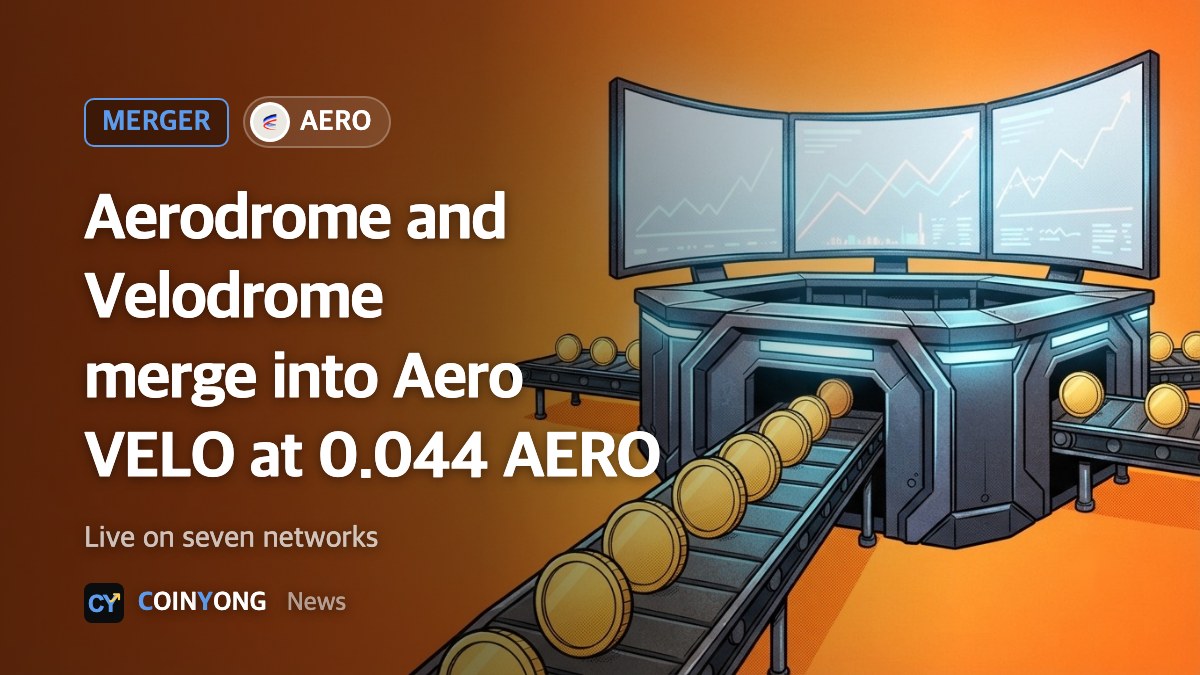
Aero, formed by merging Aerodrome and Velodrome, launched on seven networks at 9 a.m. KST on Oct. 22.
AERO converts 1:1, while each VELO converts into 0.044 new AERO; nothing converts automatically and upgrades cannot be reversed.
AERO traded at 1,065 won on Upbit, which has not yet posted a notice on the conversion.
Aerodrome and Velodrome, the flagship decentralized exchanges (DEXs) on Base and OP Mainnet, have merged into a single exchange called Aero. Aero said the two exchanges had together handled more than half of the combined trading volume on Base and OP Mainnet. The new exchange went live on Oct. 22 at 9 a.m. KST (8 p.m. EDT on Oct. 21) across seven networks: Base, Ethereum Mainnet, OP Mainnet, Arbitrum, Robinhood Chain, Ink and Arc. The two exchanges' tokens, AERO and VELO, are being replaced by a single new AERO token.
AERO converts 1:1; VELO converts at 0.044
According to Aero's upgrade hub, each existing AERO converts into one new AERO, while each VELO converts into 0.044 new AERO. The new supply is split 94.5% to the Aerodrome community and 5.5% to the Velodrome community, which Aero said matches each protocol's share of combined revenue in the 52 weeks before the merger was announced. Projected supplies at launch are 2.01 billion existing AERO and 2.66 billion VELO. Dividing Velodrome's 117 million AERO allocation by 2.66 billion VELO gives the 0.044 rate.
With the two tokens combined, total AERO supply rises from about 2 billion to a maximum of about 2.127 billion, and circulating supply from about 1.01 billion to a maximum of about 1.07 billion. Tokens that are not upgraded will never reach circulation. Aero expects realized annual inflation of about 12%, with the ceiling set at 20% at launch. Aero said the entire new AERO supply goes to existing AERO, veAERO, VELO and veVELO holders. Aerodrome and Velodrome both launched without venture backing.
Vote-escrowed locks become sAERO, with lock time intact
veAERO and veVELO, the locked positions used to vote on reward distribution, convert into sAERO, a new staked position. The remaining lock time carries over, rounded up to the next full week, and permanent locks become sAERO at the maximum stake duration. Nothing converts automatically. Self-custody holders must upgrade through the portals on aerodrome.finance or velodrome.finance, and an upgrade cannot be reversed. There is no deadline, but Aero said the legacy front ends may be shut down at a later date.
Locked positions that voted in the final Aerodrome or Velodrome epoch can upgrade one hour later, from 10 a.m. KST on Oct. 22, so final rewards can be settled first. VELO lives on OP Mainnet while the new AERO is issued on Base, so VELO held on other chains must first be bridged back to OP Mainnet. A small amount of ETH is needed for network fees. Token emissions on both legacy exchanges ended at launch.
All exchange revenue goes to stakers
Aero said 100% of exchange revenue streams to sAERO holders in real time. Instead of the old weekly voting cycle, Aero introduced Predictive Allocation, under which sAERO holders continuously choose which pools receive AERO rewards and earn a pro rata share of the revenue those pools produce. After changing an allocation, a position must wait 47 hours before changing it again. Rewards are now calculated in dollars rather than token counts, and dynamic fees rise when markets move fast.
Aero said the two exchanges have distributed more than $580 million to the people who stake their tokens. Its contracts were audited by Sherlock and ChainSecurity across five separate engagements, followed by a three-week public audit contest on Sherlock. A Sherlock bug bounty went live on launch day.
Upbit has yet to post a notice on the switch
AERO trades on the Korean won markets of Upbit and Bithumb. At around 5:30 p.m. KST on Oct. 22, it traded at 1,065 won on Upbit and 1,057 won on Bithumb, while on Binance it was at $0.80, down about 5% over 24 hours. The Upbit price was about 0.4% above the Binance price converted at 1,326 won per dollar — a gap known as the kimchi premium (the difference between prices on Korean exchanges and global markets). When Upbit listed AERO in August last year, it said it would support deposits and withdrawals only for the existing AERO contract address on the Base network. As of 5:30 p.m. KST on Oct. 22, it had not posted a separate notice about the conversion.
For AERO and VELO held on centralized exchanges, Aero said: "Aero has coordinated with all major exchanges on the upgrade details and timeline. Every exchange will coordinate their own process and timeline for upgrades." Investors holding the tokens on an exchange should check that exchange's conversion notice.
More crypto news
 XRP
 DOGE