Upbit to halt deposits and withdrawals of 25 assets including bitcoin for monthly balance audit
 Coinyong
 BTC
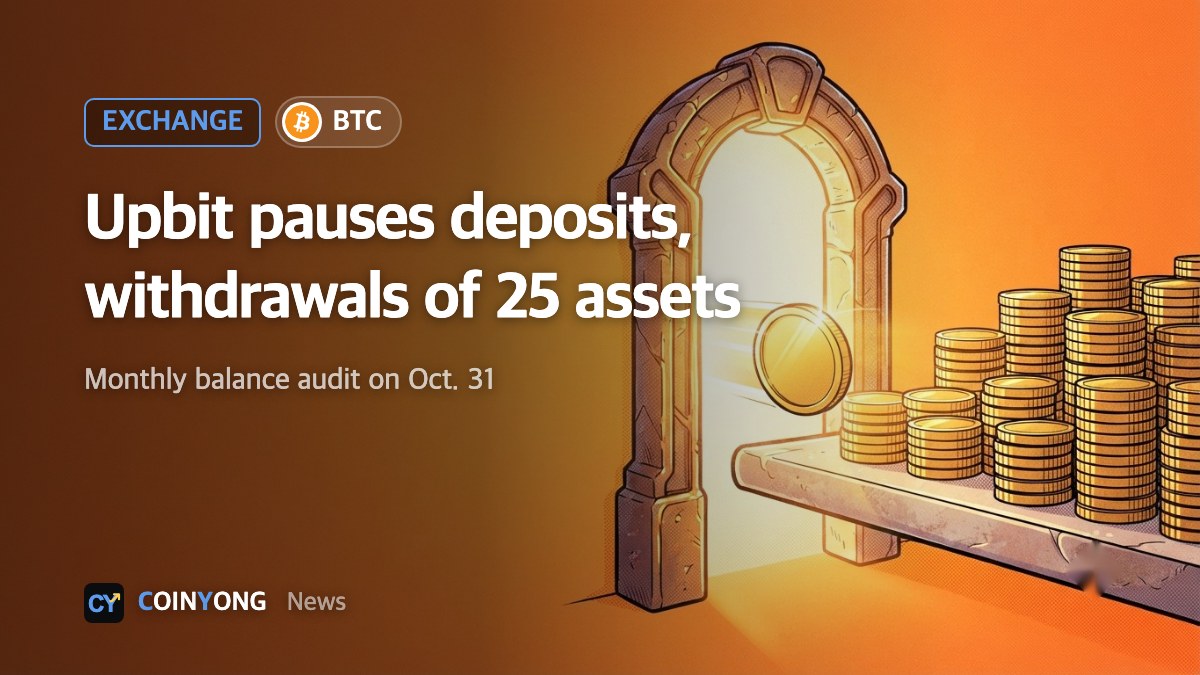
Deposits and withdrawals of 25 assets, including BTC, XRP and ETH, stop from 9 p.m. Oct. 31 to 5 a.m. Nov. 1 KST.
Staking requests for ETH, ATOM, ADA and SOL are also paused; trading and unstaking requests remain available.
Under DAXA best practices, at least 20 assets making up 80% or more of user holdings are checked every month.
Upbit will suspend deposits and withdrawals of 25 digital assets, including bitcoin (BTC), XRP and ether (ETH), for eight hours from 9 p.m. KST on Saturday, Oct. 31, until 5 a.m. on Sunday, Nov. 1. The South Korean exchange said in a notice on Oct. 26 that the halt is for a "monthly balance audit" to check that assets deposited by its members are properly held in custody. The check runs every month, separately from its existing regular audits of digital assets and won deposits.
Eight hours on Saturday night, staking requests paused too
The 25 assets are BTC, XRP, ETH, SOL, DOGE, XLM, ADA, SHIB, ONDO, ETC, LINK, NEAR, SUI, ARB, ENS, TRUMP, ENA, SEI, PEPE, ATOM, UNI, CTC, SAND, APT and CHZ. Most assets traded on Upbit's Korean won market are not affected, and trading (buying and selling) continues as normal. What stops is the movement of these 25 assets to and from other exchanges or personal wallets.
For four of them — ether, Cosmos (ATOM), Cardano (ADA) and Solana (SOL) — new staking requests will not be accepted during the same window. Unstaking requests can still be submitted, but amounts that finish unstaking will be credited to accounts only after deposits and withdrawals resume. Upbit said staking rewards and the validators it operates (nodes that verify blocks and earn rewards) are not affected. Returns of mistaken deposits and registration of withdrawal addresses are also paused during the halt and will be processed in order once services resume.
What holders need to do
Anyone planning to move these assets to another exchange or wallet should finish before 9 p.m. on Oct. 31. Upbit warned that "deposits made close to the suspension time may not be reflected normally" and advised users to leave enough time. The suspension may start or end earlier or later than scheduled, and services will reopen asset by asset. DigiByte (DGB) deposits and withdrawals will separately stop from 6 p.m. the same day because of a hard fork.
Checking at least 20 assets making up 80% or more of user holdings, every month
According to Upbit, the audit follows the Best Practices for Virtual Asset Wallet Operation and Management issued by the Digital Asset eXchange Alliance (DAXA), a self-regulatory body of South Korean exchanges. The best practices require exchanges to check balances each month for at least 20 digital assets that together account for 80% or more of the assets entrusted by users. Upbit said it chose the 25 assets under Article 7-4(1) of the best practices.
DAXA first released the best practices in September 2024, saying they were meant to help companies meet the custody duties set out in Article 7 of South Korea's Virtual Asset User Protection Act. That article requires firms to keep their own assets separate from customer assets and to actually hold the same type and amount of virtual assets that customers have entrusted to them. The original best practices called for wallet access rights to be split among at least three people, with one of the roles covering withdrawal monitoring and daily balance reconciliation (matching ledger records against wallet holdings).
Separately, Upbit has carried out regular audits through an outside accounting firm. For its most recent regular audit, it halted digital asset deposits and withdrawals for 12 hours, from 8 p.m. on Sept. 30 to 8 a.m. on Oct. 1. In an audit report released on Sept. 18 (by BDO Sunghyun Accounting Corporation, as of midnight on Sept. 1), it said it held about 103.64% of the won value of the 25 covered assets it owes to members. According to the report, members had entrusted 174,276 BTC to Upbit, while Upbit's wallets held 174,550 BTC. Members also had about 6.426 billion XRP and 2,267,789 ETH on deposit.
Beyond matching ledger quantities against wallet balances looked up on the blockchain, the accounting firm also ran a "small-amount transfer test," selecting some Upbit wallets and having Upbit move a small amount set by the firm to another wallet, and an "electronic signature verification," having Upbit sign a message provided by the firm with a wallet key. These steps check that the company actually controls the wallets. However, the report stated that the work was not an audit or review under accounting standards and that it does not express assurance about the digital assets.
Six assets changed from the September list
Comparing the 25 assets in the report as of Sept. 1 with the new list, 19 remain the same. Six were dropped — Cronos (CRO), Polkadot (DOT), Axie Infinity (AXS), Stacks (STX), Avalanche (AVAX) and Worldcoin (WLD) — and six were added: Cardano (ADA), Sui (SUI), Official Trump (TRUMP), Sei (SEI), Uniswap (UNI) and Chiliz (CHZ). Creditcoin (CTC), a Korean project, appears on both lists.
Around 10:30 p.m. KST on Oct. 26, bitcoin traded at 106,359,000 won on Upbit. Binance's price converted into won at the same time was about 105.55 million won, putting the Korean price about 0.77% higher, a gap known as the kimchi premium (the difference between prices on Korean exchanges and global markets). XRP traded at 1,719 won and ether at 3,081,000 won.
More crypto news
 XRP
BTC
 INIT
 DGB