Polkadot launches dotUSD, a stablecoin with no issuer, with 98.5% approval
 Coinyong
 DOT
DOT
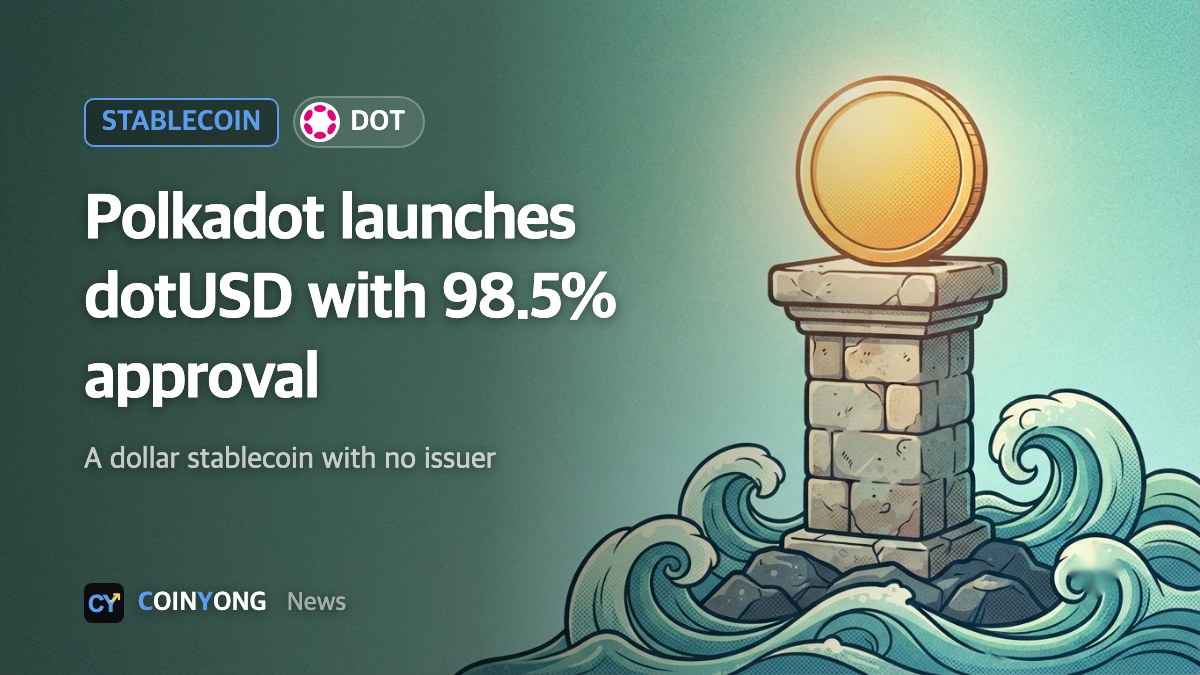
Referendum 1944 passed with 98.5% approval and was executed onchain on Oct. 8.
Phase 1 mints dotUSD 1:1 against USDT, with $5 million in treasury funds seeding a pool.
Phase 2 adds DOT-backed loans in which borrowers set their own interest rates.
Polkadot has switched on dotUSD, a dollar stablecoin with no issuing company behind it, after token holders approved it in a public vote. OpenGov Referendum 1944 was executed onchain on Oct. 8 at 4:31 p.m. KST, and Polkadot announced on its official X account that night that "dotUSD is live on Polkadot." In the first phase, the only route open is depositing Tether (USDT) to mint dotUSD one-for-one.
"Today a handful of companies issue and control most of the world's stablecoins worth more than $250B. Like banks, they decide who can hold them and who can't. dotUSD is based on a different premise. It has no issuing company and no single point of control."
Polkadot official X account (Oct. 8)
A month from proposal to execution
The referendum, titled "dotUSD: A Native Stablecoin for Polkadot," ran on the Root track, which handles proposals that require the highest level of privilege. The onchain record shows the following timeline (KST).
- Referendum 1944 on dotUSD submitted
- Decision deposit placed; referendum entered the decision period
- System chains upgraded to version 2.5 (Referendum 1942), a prerequisite for the dotUSD proposal
- Ayes maintained their lead; referendum entered the confirmation period
- Referendum confirmed
- Executed onchain; official X announcement follows at 21:35 the same day
At confirmation, the tally stood at about 4.63 million aye votes to about 70,000 nay votes, a 98.5% approval rate. Polkadot voting gives extra weight to tokens locked for longer, so vote counts differ from the amount of DOT actually used to vote. The proposal was submitted by the Polkadot Community Foundation (PCF), which stated that it put the proposal forward only "in an administrative capacity" and will not operate dotUSD or take custody of user assets.
$5 million from the treasury seeds first liquidity
The referendum bundled seven actions. They include creating dotUSD as a new asset owned by the protocol, recognizing it as Polkadot's official stablecoin, and opening a DOT-dotUSD liquidity pool on Polkadot Asset Hub. Initial liquidity for the pool comes from the Polkadot treasury: $2.5 million in USDT will be used to mint dotUSD, and $2.5 million in DOT will be added alongside it. dotUSD was also set as a "sufficient" asset, so an account holding only dotUSD can exist onchain, letting users without DOT use it.
Phase 1 opens only the Peg Stability Module (PSM). Users deposit USDT to receive dotUSD one-for-one and can redeem it for $1 in the other direction, subject to a cap on supply. The proposal said this phase comes first because it needs no oracle to pull in prices and no collateral liquidation mechanism.
Phase 2 adds DOT-backed loans, with borrowers setting their own rates
Phase 2 adds a vault system in which users lock DOT as collateral to borrow dotUSD. The design draws on Liquity v2 (BOLD), a decentralized stablecoin on Ethereum. In the proposal's example, depositing 300 DOT at $5 each, or $1,500 worth, allows minting up to $1,000 in dotUSD, a 150% collateralization ratio. That example assumes a DOT price of $5.
A key feature is that borrowers set their own interest rates. If dotUSD falls below $1 and someone redeems dotUSD for DOT, collateral is taken first from the vaults with the lowest rates. Vaults whose collateral value falls below the threshold are liquidated against the Stability Pool, where participants who deposited dotUSD receive DOT at a discount.
The proposal also acknowledged a weakness: because DOT, the network's own token, serves as collateral, DOT's price and dotUSD affect each other. It said keeping a separate USDT-backed buffer from Phase 1 is meant to defend the $1 peg without touching DOT. Polkadot earlier set a hard cap of 2.1 billion DOT, and the proposal said dotUSD will also be used for planned stablecoin payments to validators and nominators.
DOT rose 13% the day after execution, trading at 1,717 won on Upbit
On Binance daily candles (UTC), DOT fell as low as $1.009 on Oct. 8, the day the referendum was executed, before closing at $1.090. It rose 13.4% to $1.236 on Oct. 9, and DOT was trading around $1.26 in the Oct. 10 (UTC) session as of 7:30 a.m. KST on Oct. 11. At that time, DOT traded at 1,717 won on Upbit's Korean won market and 1,716 won on Bithumb. The Binance price converts to about 1,692 won, putting the kimchi premium (the gap between prices on Korean exchanges and global markets) at about 1.5%. Upbit's 52-week low for DOT is 1,021 won on Aug. 18, and its high is 5,200 won on Nov. 8, 2025. The Binance DOT futures funding rate stood at 0.01% at the same time.
More crypto news
 BTC
BTC
 XRP
XRP
 CVC
CVC