Ethereum devs set Dec. 15 for Glamsterdam upgrade on Hoodi testnet, keep gas rule unchanged
 Coinyong
 ETH
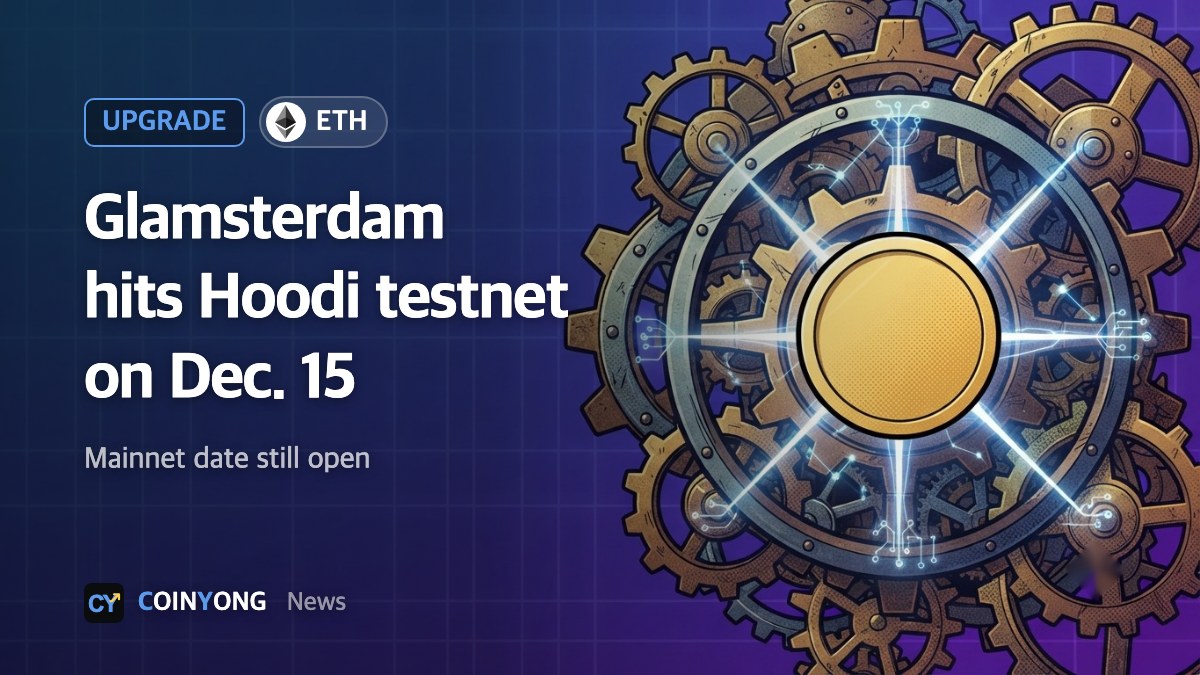
Hoodi activation is set for Dec. 15 at 19:12 UTC, or Dec. 16 at 4:12 a.m. KST.
The disputed EIP-8037 gas rule will ship as-is, with no spec changes.
Mainnet is still unscheduled; an EF report put mid-January as the earliest date.
Ethereum's next upgrade, Glamsterdam, has a new date on its second public testnet after being on hold for more than a month. Core developers on the All Core Devs Consensus call (ACDC #192) on Nov. 26 (UTC) agreed to activate the upgrade on the Hoodi testnet on Dec. 15 at 19:12 UTC, at epoch 143,616. That is 4:12 a.m. on Dec. 16 in Korea.
The Hoodi fork had originally been set for the early hours of Oct. 27 KST, but it was postponed indefinitely on Oct. 22 after warnings that the new gas rules could break smart contracts already deployed on Ethereum. The decision comes five weeks after the postponement and puts the Hoodi activation about seven weeks behind its original schedule.
Hoodi goes at 4:12 a.m. KST on Dec. 16
According to the meeting summary, developers picked Dec. 15 over Dec. 16. Jihoon, who handles the consensus specs, is to review two pending PRs and then cut a spec release, while execution and consensus client teams agreed to ship Hoodi-ready releases by early next week. The summary also said Potuz of the Prysm client team expressed strong opposition to the timing.
| Oct. 6 | Glamsterdam activates on Sepolia, the first public testnet |
|---|---|
| Oct. 22 | Hoodi activation postponed to study the impact of EIP-8037; no new date |
| Nov. 6 | Ethereum Foundation publishes a list of invariants that could break and asks contract developers to check their code |
| Nov. 19 | Execution-layer call (ACDE #249) reaches rough consensus to keep the current spec and weighs a Hoodi fork in the week of Dec. 14 |
| Nov. 26 | Consensus-layer call (ACDC #192) sets the Hoodi date |
| Dec. 15, 19:12 UTC | Glamsterdam activates on the Hoodi testnet (epoch 143,616) |
| TBD | Mainnet activation |
The gas rule ships as written
EIP-8037, the proposal behind the delay, sharply raises the gas charged for creating new accounts and storage (state creation gas) and meters it separately from regular execution gas. The EIP says the costs are calibrated to target average state growth of about 120 GiB a year at a reference block gas limit of 150 million. The problem was that the design could break assumptions some contracts rely on, such as the idea that remaining gas only ever goes down.
In a Nov. 6 blog post, the Ethereum Foundation said security firm ChainSecurity had found projects that could become vulnerable after Glamsterdam, published a repository of eight invariants that the changes could break and asked developers to check their own projects. On the Nov. 19 execution-layer call, some developers argued for changing the spec so contracts would not break, while others said a late change carried a greater risk of new bugs and delays. On this week's call, execution-layer teams reached rough consensus to ship EIP-8037 under the current spec. The summary noted that concerns remained about potential breakage and the usability of the gas opcode.
"EL teams agreed to ship EIP-8037 as-is, with no spec changes."
ACDC #192 meeting notes (EIPsInsight)
A stopgap fix for builder payloads
On the consensus layer, the open question was how to validate the execution payloads that block builders hand over. Two options were on the table: PR 5770, a non-consensus-breaking fix, and PR 5820, which changes consensus rules. According to the meeting summary, many teams considered 5820 the better technical solution, but given the timeline they chose 5770 because it does not break consensus and can be implemented faster, deferring 5820. The summary also noted that 5770 was considered a "hack."
Mainnet no earlier than mid-January
Developers again did not set a mainnet date. According to the summary of the Nov. 19 execution-layer call, Rahul of the Ethereum Foundation reported that outreach to more than 50 affected companies indicated mid-January as the earliest viable mainnet date if the spec stays unchanged. The previous upgrade, Fusaka, went live on mainnet in December 2025. The scope of the following upgrade, Hegotá, will be revisited on the next consensus-layer call, about two weeks away.
Hoodi is a testnet for node operators and developers, and ordinary ETH holders do not need to take any action. As of 8:38 p.m. KST on Nov. 27, ETH traded at 2,336,000 won on Upbit, up 1.9% from a day earlier, and at $1,728 on Binance. The Upbit price was about 0.6% above the won-converted Binance price, a gap known as the kimchi premium. The most recent settled funding rate on Binance's ETH perpetual futures was 0.0070%.
More crypto news
 XRP
 BNB
 SKY
 LINK