South Korea to require crypto transfers abroad be reported to central bank from Dec. 3
 Coinyong
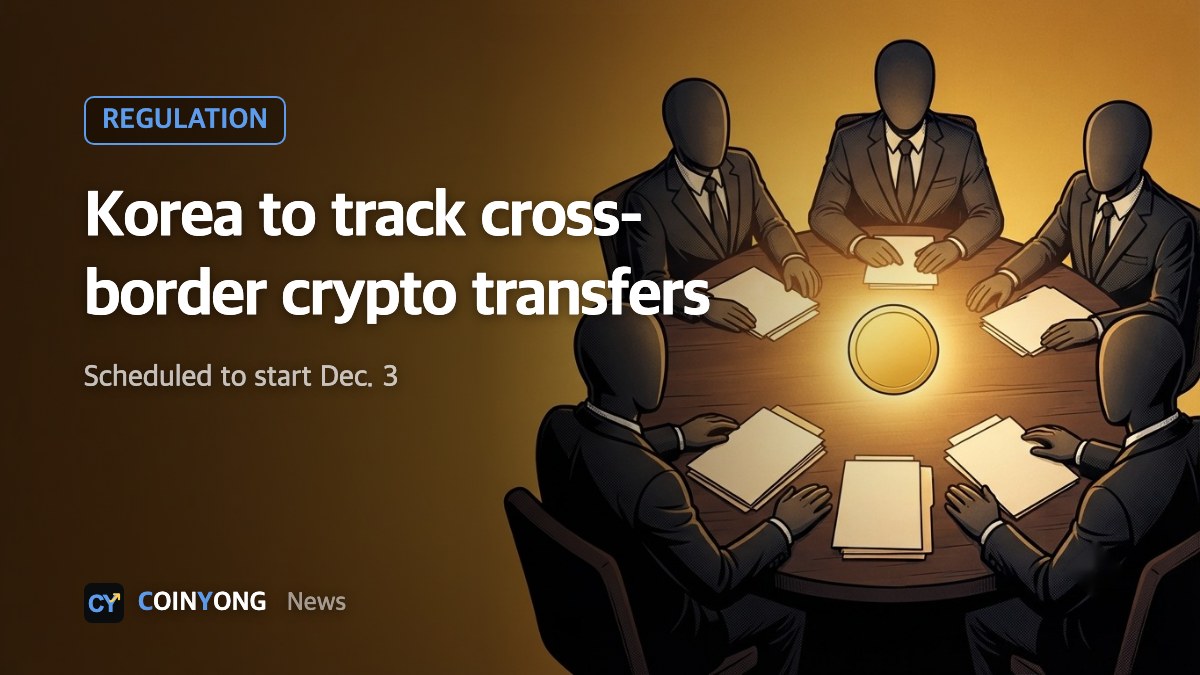
Transfers between Korean exchanges and overseas exchanges or self-custody wallets fall under the new 'virtual asset transfer business.'
Transfer records will go to the Bank of Korea's FX system and be shared with tax, customs and financial authorities.
Currency exchangers caught in crypto-linked illegal remittances lose registration on a first offense; the rules are slated to take effect Dec. 3.
Records of crypto moved from South Korean exchanges to overseas exchanges or self-custody wallets will be collected in the Bank of Korea's foreign exchange data system under a draft decree South Korea's Ministry of Finance and Economy put out for public comment on Oct. 7. The draft enforcement decree of the Foreign Exchange Transactions Act fills in the details of an amendment to the act promulgated on June 2, and is scheduled to take effect on Dec. 3, the same day as the amended act.
Overseas exchange or personal wallet, both count as a transfer
The core of the draft defines the scope of the "virtual asset transfer business" newly created by the act. The ministry included both transfers between domestic and overseas virtual asset service providers and transfers between domestic providers and personal wallets. A personal wallet is one the user controls directly, rather than one held at an exchange.
The amended Foreign Exchange Transactions Act requires businesses handling cross-border virtual asset transfers to register with the minister of finance and economy in advance. The National Assembly passed the bill on May 7, the Cabinet approved it on May 26, and it was promulgated on June 2. Businesses that fail to register or refuse reporting and inspection requests face sanctions comparable to those for banks and other existing foreign exchange institutions.
This is not the only mechanism tracking crypto transfers. On Aug. 11, the Financial Intelligence Unit under the Financial Services Commission (FSC) secured Cabinet approval for an amendment to the enforcement decree of the Act on Reporting and Using Specified Financial Transaction Information, scrapping the 1 million won threshold for the travel rule, which requires sender and recipient information to accompany a transfer. The amendment also lets the scope of permitted dealings with overseas providers and personal wallets vary by risk level. Where the financial transaction information act is an anti-money-laundering tool, the new Foreign Exchange Transactions Act decree separately records cross-border transfers for foreign exchange oversight.
Registration requires IT systems and two qualified staff
To register as a virtual asset transfer business, the draft requires the computer systems needed for the work and at least two staff members who either have two or more years of foreign exchange experience or have completed relevant training. It also sets out what must be registered and which changes must be reported.
Registered virtual asset transfer businesses must report transfer records to the Bank of Korea's foreign exchange data system, the designated foreign exchange data hub. The ministry said it plans to share the data with the National Tax Service, the Korea Customs Service, the Financial Supervisory Service (FSS) and the Financial Intelligence Unit. The ministry said the integrated monitoring system for cross-border virtual asset transfers would help prevent the use of crypto to get around foreign exchange rules or carry out illegal transactions.
Exchangers caught in crypto-linked illegal remittances lose registration on first offense
The draft also tightens rules on currency exchange businesses. The National Assembly and others had pointed out that the sector has no entry requirements, allowing weak operators to proliferate. Of the 1,346 exchangers that reported results for the first half of this year, 581 had made no foreign currency purchases at all.
The draft requires currency exchangers to hold equity capital at a level of at least 10 million won, as set by ministerial notice, and bars executives who fall under the disqualification grounds of the Act on Corporate Governance of Financial Companies. Exchangers caught in voice phishing, illegal trade payments or crypto-related illegal remittances would have their registration canceled on a first offense under a "one-strike-out" rule. The cap on fines imposed in lieu of business suspension would rise from 70% to 100% of the gains from the violation, based on a four-month suspension.
The Korea Customs Service's inspection powers will also widen, allowing it to continue inspecting service and capital transaction violations it uncovers while examining import and export deals. Small-sum overseas remittance and other specialized foreign exchange businesses will be merged into a single "overseas payment and settlement business," with two new types, payment escrow and electronic bill presentment and payment, bringing the total to six. Once the decree is finalized, the ministry plans to revise the Foreign Exchange Transactions Regulations to allow foreign currency prepaid instruments to be transferred to others within a set limit, moving services that have operated in the financial regulatory sandbox, such as Travel Wallet, into the formal system.
Comments due Oct. 26, rules scheduled for Dec. 3
| May 7 | National Assembly passes the Foreign Exchange Transactions Act amendment |
|---|---|
| June 2 | Amended act promulgated |
| Oct. 7–26 | Draft enforcement decree out for public comment |
| Dec. 3 | Amended act and decree scheduled to take effect |
After the comment period, the draft goes through regulatory review by the Office for Government Policy Coordination and a review by the Ministry of Government Legislation, followed by the vice ministers' meeting and the Cabinet. Comments will be accepted until Oct. 26.
At 10:30 a.m. KST on Oct. 7, the day the draft was released, bitcoin traded at 115.6 million won on Upbit. The Binance price at the same time converted to about 114.26 million won, putting the kimchi premium (the gap between prices on Korean exchanges and global markets) at about 1.2%.
More crypto news
 USDT
USDT
 PENGU
PENGU
 ARB
ARB
 ETH
ETH