Russia to let retail investors buy bitcoin from Nov. 17, capped at 300,000 rubles per intermediary
 Coinyong
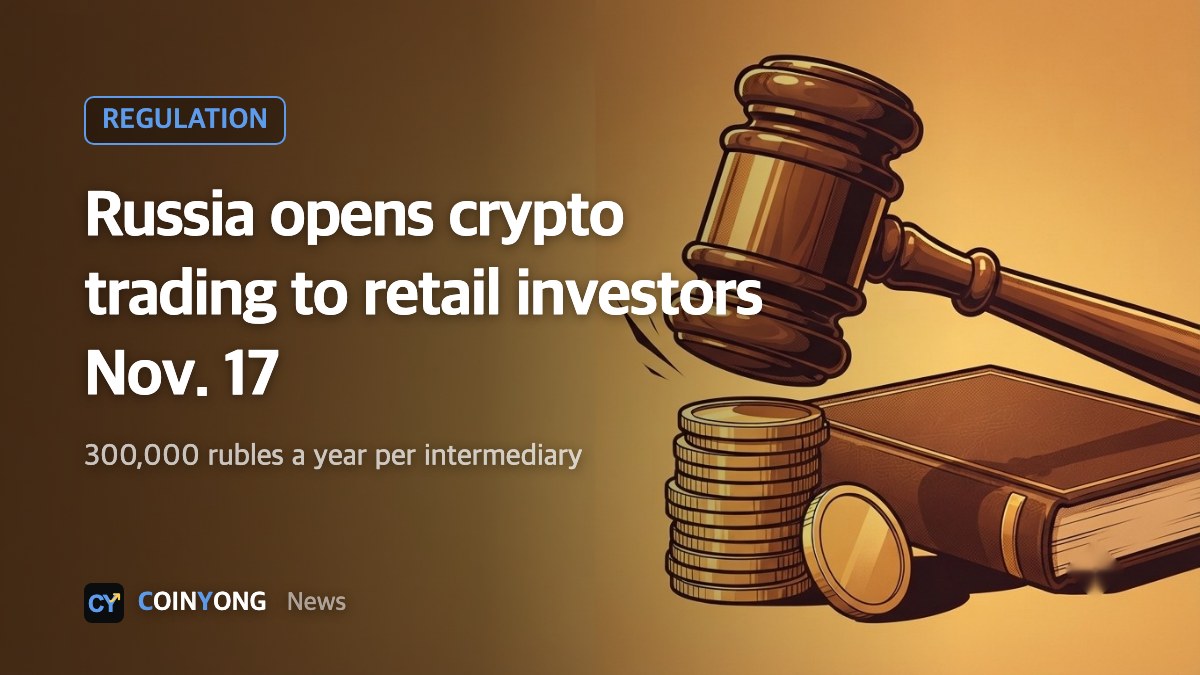
Russia's central bank named BTC, ETH and USDT as the coins open to retail investors on Nov. 6.
Retail purchases are capped at 300,000 rubles (about 4.9 million won) a year per intermediary, and every investor must pass a test.
The directive takes effect Nov. 17, and the Moscow Exchange starts pilot trading on Dec. 1.
Russia's central bank has settled on bitcoin (BTC), ether (ETH) and Tether's USDT as the only cryptocurrencies ordinary retail investors will be allowed to buy, saying on Nov. 6 that its directive takes effect on Nov. 17. From that date, Russian exchanges may admit the three assets to public trading, and the Moscow Exchange plans to start trading them on Dec. 1.
The core provisions of Russia's federal law on digital currencies and digital rights (No. 282-FZ) took effect on Sept. 1, opening the way for exchanges and intermediaries to handle crypto under central bank supervision. The new directive spells out what non-professional investors can buy and how much.
Five years of price history abroad
The Bank of Russia said only the most liquid assets made the list, based on criteria set out in the law: market capitalization, average daily trading volume and a price history on foreign platforms of at least five years. The central bank said the approach is meant to reduce risks for non-qualified investors putting money into crypto assets.
The same three assets appeared in a draft directive published on Aug. 11. At the time, the central bank said non-qualified investors would be limited to the most liquid coins to protect them from "sharp and unpredictable fluctuations," and it took comments until Aug. 24. Nearly three months later, the final directive kept the list unchanged. Other large tokens such as XRP and Solana (SOL) were left off the retail list.
300,000 rubles a year per intermediary, plus a test
Non-qualified investors will be able to buy the three assets through intermediaries such as brokers, asset managers and crypto exchange operators, on both exchange and over-the-counter markets. Purchases are capped at 300,000 rubles a year per intermediary, or about $3,650 and roughly 4.9 million won at the Bank of Russia's official rates for Nov. 7. Because the cap applies per intermediary, an investor using several of them can buy more in total.
Qualified investors, who must meet asset or experience requirements, face no cap and can buy any crypto asset without restriction. All investors, regardless of status, must pass a test and read a disclosure about the risks of investing in cryptocurrency before trading.
Moscow Exchange opens on Dec. 1
The Moscow Exchange, Russia's largest securities exchange, said in a Nov. 2 press release that it plans to offer digital currency trading from Dec. 1, describing it as the first organized digital currency market in Russia. BTC, ETH and USDT will be the first instruments, and the launch will begin with pilot trades, with participants connected gradually as they become ready.
Trading will run on the exchange's stock market technology, with clearing by its subsidiary, the National Clearing Centre (NCC). Same-day (TOD) and next-day (TOM) settlement will be available alongside swap transactions for liquidity management. Trading hours will match the stock market, from 6:50 a.m. to 11:50 p.m. Moscow time, or 12:50 p.m. to 5:50 a.m. the next day in Korea. The exchange said it will later expand the list with international and Russian digital currencies and digital assets.
| Aug. 11 | Central bank publishes draft directive on retail limits and eligible coins |
|---|---|
| Sept. 1 | Core provisions of the digital currencies and digital rights law take effect |
| Oct. 6 | First five digital depositories and four crypto exchange operators registered |
| Nov. 6 | Central bank announces final directive |
| Nov. 17 | Directive takes effect; exchanges may admit the three assets to public trading |
| Dec. 1 | Moscow Exchange begins trading (pilot trades) |
| Sept. 1, 2027 | Deadline for registered firms to meet the law's requirements |
Nine registered firms and a sanctioned exchange
The regulated infrastructure has been coming together since last month. On Oct. 6, the central bank entered the first five digital depositories, which hold and transfer crypto, and four crypto exchange operators into its registers. They were admitted to the financial market under the law's transitional provisions and must fully meet its requirements by Sept. 1, 2027. On Oct. 29, the first self-regulatory organization (SRO) was registered; registered firms must join one within 90 days.
The Moscow Exchange and the NCC are under U.S. sanctions. On June 12, 2024, the U.S. Treasury announced sanctions targeting Russia's war economy and designated the two, along with the National Settlement Depository (NSD), for operating in the financial services sector of the Russian economy under Executive Order 14024. On Upbit's Korean won market, bitcoin traded at 103.62 million won, ether at 3.055 million won and Tether at 1,364 won as of 8:33 p.m. KST on Nov. 8. At the same time, Upbit's bitcoin price was about 0.62% above Binance's price converted into won, a gap known as the kimchi premium (the difference between prices on Korean exchanges and global markets).
More crypto news
 SKY
 ACE
 FLIP
 CYBER