South Korea's draft Digital Asset Act would cap exchange shareholders' stakes at 20%
 Coinyong
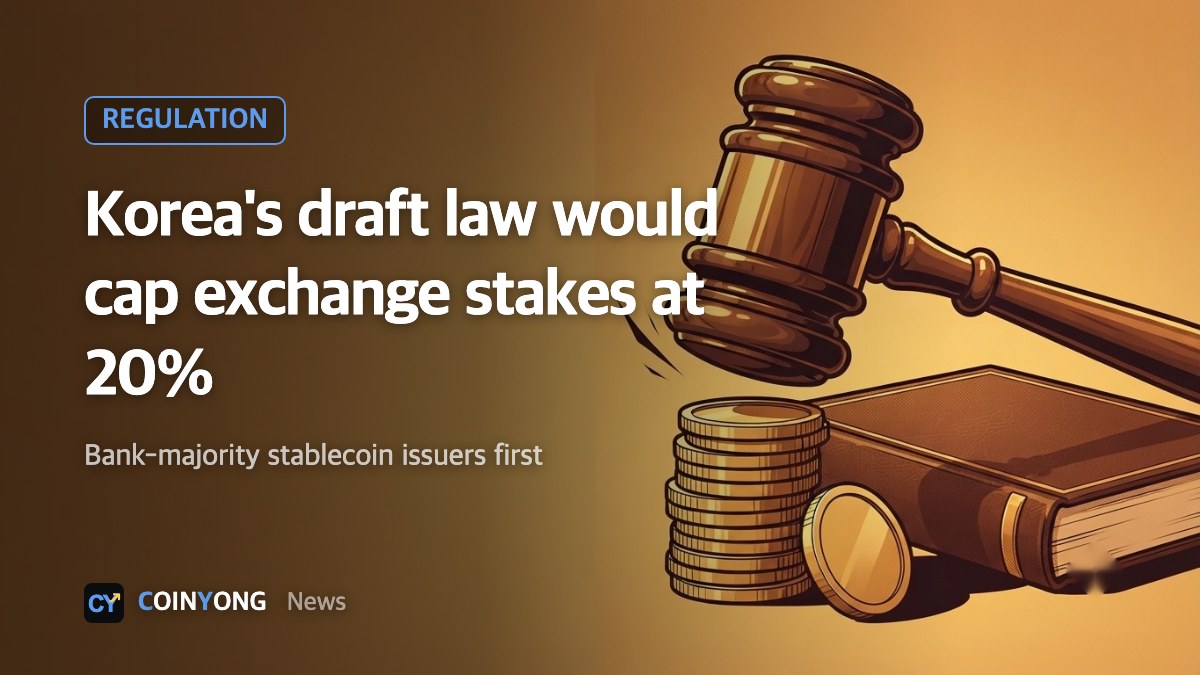
Major shareholders' stakes in exchanges capped at 20%, up to 34% with FSC approval, with a three-year grace period after designation
Stablecoins to be issued first by bank-majority consortiums, with at least 5 billion won in equity and reserves of at least 100%
Domestic ICOs allowed after a white paper filing and deliberation period; firms liable for hacks and outages even without fault
Major shareholders of South Korean crypto exchanges such as Upbit and Bithumb would be limited to a 20% stake in principle under a draft law discussed by the Financial Services Commission (FSC) on Nov. 24. The FSC said it convened its Virtual Asset Committee, chaired by FSC Chairman Lee Eog-weon, at the Government Complex Seoul that afternoon to discuss plans to enact the Act on Innovation in the Digital Asset Industry and User Protection (the Digital Asset Act). The bill also sets rules for issuing won-pegged stablecoins, allows domestic initial coin offerings (ICOs) and makes firms liable for losses from hacks even when they are not at fault.
South Korea's crypto rules have so far been split between the Act on Reporting and Using Specified Financial Transaction Information, which covers operator registration and anti-money laundering, and the Virtual Asset User Protection Act, in force since July 2024, which covers safeguarding user assets and unfair trading. The FSC said that framework focused on preventing illegal activity and investor harm, and critics argued it had left the market concentrated around exchanges and retail investors. The new bill is meant to cover the industry, the market and users in a single law.
Exchange ownership capped at 20%, as with alternative trading systems
The bill splits the industry into four types of digital asset businesses — dealing, brokerage, custody and asset management — plus digital asset platform operators, or exchanges. Dealing, brokerage and custody require a license, while asset management, which does not hold user assets directly, requires only registration and at least 500 million won in equity. The FSC can designate firms that hold all three licenses and meet further requirements as exchanges.
Major shareholders of exchanges would be limited to 20%, in line with alternative trading systems (ATS) for equities, though the FSC plans to allow up to 34% with its approval through an enforcement decree. Shares above the cap would carry no voting rights. To give existing exchanges time to comply, the cap would not apply for three years after designation, and that grace period could be extended by up to three more years for small and mid-sized exchanges that need to raise capital. Order matching, token listings and market surveillance, now handled through industry self-regulation, would become subject to statutory oversight.
Won stablecoins to start with bank-majority issuers
The bill calls stablecoins "digital payment tokens" and defines them as digital assets that are pegged to the value of a single currency to keep a stable value and are mainly used as a means of payment. Issuers would need an FSC license and at least 5 billion won in equity, among other requirements. Shareholder requirements will be set by enforcement decree, but initially only consortiums in which banks hold a majority stake would be allowed to issue. Fintech and technology companies could still take part as the largest single shareholder.
Issuers must deposit or place in trust reserve assets equal to at least 100% of outstanding tokens with reserve custodians such as banks, and they may not pay interest to holders. They must redeem tokens for money of equal value without delay upon request. Stablecoins without an approved or filed issuance plan could not be listed on Korean exchanges or traded, brokered or held in custody by digital asset businesses. The FSC could designate tokens with at least 1 trillion won outstanding as "significant digital payment tokens."
Domestic ICOs reopened, with a white paper required
ICOs, in which projects issue and sell new tokens, would be allowed on the condition of disclosure. Issuers would have to file a "digital asset white paper" with the FSC in advance, similar to a securities registration statement, covering the use of proceeds, issuance volume, project details and risks. Sales could begin only after the filing is accepted, disclosed and followed by a deliberation period. The FSC cited a case in May 2025 in which a platform company got around Korea's ICO ban by setting up a foundation abroad, issuing a token there and circulating it on domestic exchanges. Exchanges would also have to file and disclose a "listing report" when listing a token, and immediately disclose hacks and changes in circulating supply.
Firms to compensate users for hacks even without fault
If a hack or system outage occurs, digital asset businesses would have to compensate users for losses even if they were not at fault. Where an incident results from a breach of IT security obligations, the FSC could impose a punitive financial penalty of up to 10% of revenue. The FSC pointed to a November 2025 case in which user assets held in an exchange wallet were transferred out of the exchange's wallet without authorization. Unfair-trading rules would extend to tokens under listing review, and the FSC could vote to freeze accounts when there are substantial grounds for suspicion. The bill also introduces leniency for those who self-report and rewards for whistleblowers.
"It will serve as an opportunity to strengthen trust and transparency in our digital asset market while lifting the industry's competitiveness to the next level."
Lee Eog-weon, FSC Chairman
Lee said the government would do its best to have the bill enacted promptly after sufficient debate in the National Assembly. The bill takes effect only after it passes the National Assembly. On the day of the announcement, bitcoin traded at 81,555,000 won on Upbit as of 8:30 p.m. KST.
More crypto news
 USDC
 SKY
 ACE
 FLIP