Lloyds settles $750,000 with Visa in USDC, funds arrive in under an hour
 Coinyong
 USDC
USDC
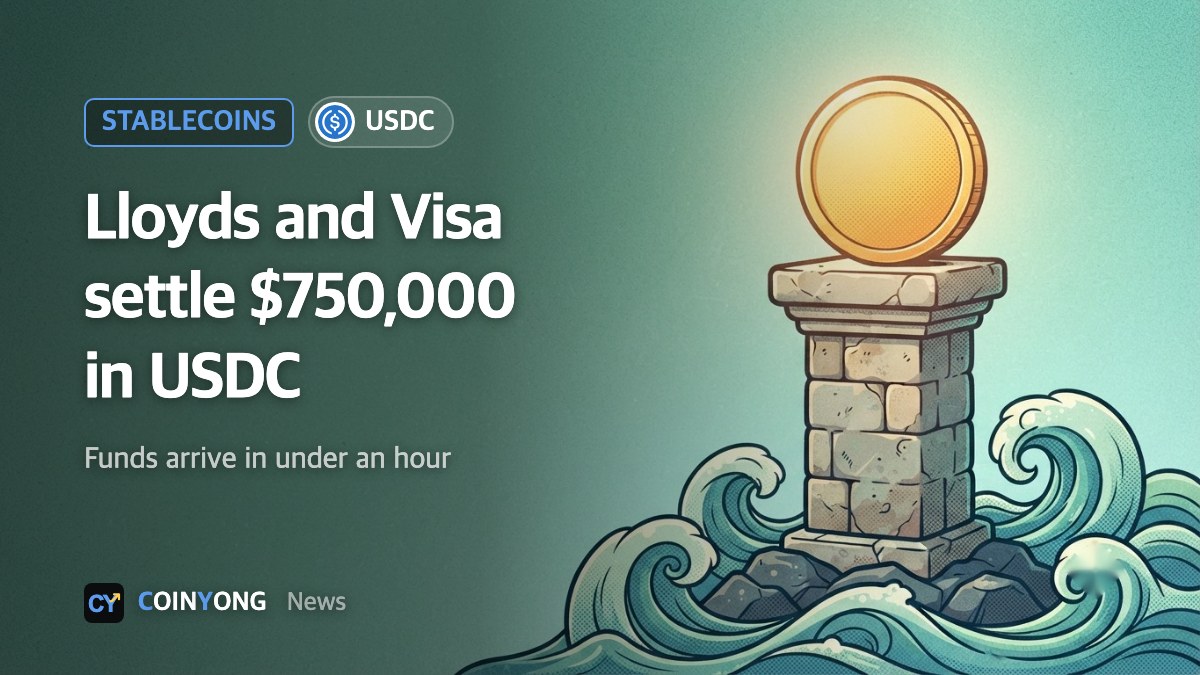
Lloyds settled $750,000 of payment obligations with Visa in USDC over a seven-day pilot.
Funds reached Visa in the U.S. in under an hour, including over the weekend.
It was the first stablecoin settlement trial between Visa and a major UK banking group.
UK banking group Lloyds Banking Group settled $750,000 of payment obligations it owed card network Visa using the dollar-pegged stablecoin USDC. Lloyds said in a Sept. 30 press release that it had completed the seven-day live pilot and that funds reached Visa in under an hour, including over the weekend. The company described it as the first stablecoin settlement trial between Visa and a major UK banking group.
Weekend transfers arrived within the hour
The test did not cover how consumers pay by card. It focused on settlement, the behind-the-scenes process through which financial institutions exchange funds to complete and reconcile payment activity. Lloyds used USDC to settle a series of settlement obligations denominated in U.S. dollars totaling $750,000. USDC is a dollar-pegged stablecoin issued by U.S.-based Circle and is designed to hold a value of $1 per token.
Lloyds bought the USDC used in the pilot through Archax, a UK-regulated digital asset exchange. The transactions were booked through Lloyds' Corporate Markets branch in Jersey and then transferred to Visa in the U.S. Lloyds said that under traditional cross-border payment processes, settlement can take a day or more if initiated outside banking hours. In the pilot, funds sent over the weekend still reached Visa in under an hour.
Canton on the bank side, a public chain for Visa
The two companies also tested whether settlement could work across different blockchains. Lloyds ran its own node on the Canton Network, an institutional blockchain, using its configurable privacy features to control what transaction details are shared, while Visa received the settlement on a separate public blockchain. Lloyds did not name the public blockchain.
"Settling $750,000 of live payment obligations between Lloyds and Visa using stablecoins has allowed us to move beyond theory and test these capabilities in a real-world setting."
Peter Left, Head of Digital Assets at Lloyds Banking Group
Rob Cameron, Visa's Group Country Manager for the UK and Ireland, said: "This pilot with Lloyds shows how stablecoins can work alongside existing banking infrastructure to give financial institutions more choice over how and when they settle funds." Lloyds added that the initiative is part of its wider work to explore how digital assets and tokenized forms of money could enhance the movement of value between businesses and financial institutions.
Visa's stablecoin settlement tops $20 billion in under a year
Visa has said it first experimented with USDC settlement in 2021 and has been settling transactions in stablecoins since 2023. On Dec. 16, 2025, it launched USDC settlement in the United States, with Cross River Bank and Lead Bank as the first participants, settling with Visa in USDC over the Solana blockchain. At the time, Visa's stablecoin settlement volume stood at a $3.5 billion annualized run rate as of Nov. 30, 2025.
On April 29 this year, Visa said it had added five blockchains to its settlement pilot — Arc, Base, Canton, Polygon and Tempo — bringing the total to nine. It already supported Avalanche, Ethereum, Solana and Stellar. Visa said its stablecoin settlement run rate had reached $7 billion annualized, up 50% from the previous quarter. Canton, which Lloyds used in this pilot, was among the chains added then. In a Sept. 8 post on its website, Visa said stablecoin settlement volume had recently surpassed a $20 billion annualized run rate, up more than 15 times year over year. The run rate has climbed from $3.5 billion at the end of November 2025 to $7 billion in April and above $20 billion in less than a year.
USDC trades at 1,364 won on Upbit
USDC is also listed on Korean won markets in South Korea. As of 8:31 p.m. KST on Oct. 1, USDC traded at 1,364 won on Upbit and 1,365 won on Bithumb. Binance's price at the same time converted to about 1,356 won, putting the kimchi premium (the gap between prices on Korean exchanges and global markets) at about 0.6%. Upbit's 24-hour USDC trading value was about 1.26 billion won, roughly one-sixtieth of the about 74.9 billion won traded in Tether (USDT) over the same period.
More crypto news
 XRP
XRP
 ETH
ETH