Kraken retracts emails questioning Monero buyers, calls them a mistake
 Coinyong
 XMR
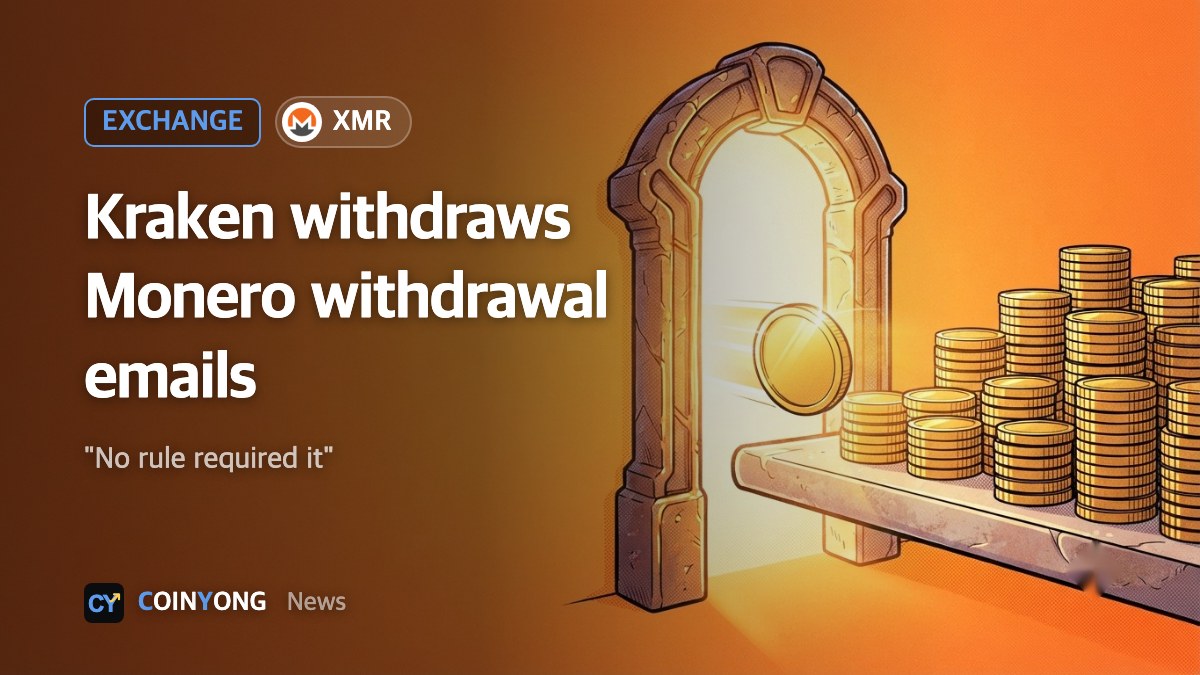
Kraken withdrew emails asking Monero buyers who withdrew XMR about their employer, source of funds and plans for the coins.
Co-CEO Arjun Sethi said "no rule required it" and scrapped the question about what clients would do with their coins.
XMR stays listed, and Kraken's standard source-of-funds checks remain in place.
Kraken has withdrawn requests for additional information it emailed to customers who bought Monero (XMR) and withdrew it to their own wallets. Co-CEO Arjun Sethi said in a post on X at 11:15 a.m. KST on Oct. 24 that "the monero:native emails were us. they were wrong." Monero is a so-called privacy coin with strong features for hiding transaction details.
"A young client with a lot of money" seen as a red flag
According to Sethi, clients who bought XMR with their own money and withdrew it received an email asking for their employer, the source of their funds and what they planned to do with their coins. "No rule required it," he wrote, adding that the request began when an employee saw a young client with a lot of money and treated it as a red flag.
"that is not a red flag. that is our customer and client"
Arjun Sethi, co-CEO of Kraken
Sethi said the requests had all been withdrawn and that affected clients had been told nothing was required of them. He said the question about what clients would do with their coins had been removed entirely, calling it "unacceptable." "Where your money came from is a fair question. What you do with it after it leaves is not," he wrote. He added: "xmr stays listed. buy it here, take it home."
Source-of-funds checks stay in place
What Kraken withdrew was a specific email sent to Monero withdrawal customers; its general additional-information request process has not changed. A Kraken support article last updated on Oct. 1 describes such requests as "a normal part of keeping Kraken secure and meeting our legal and regulatory obligations." If a request expires without a response, Kraken may pause some account activity such as trading and deposits, but withdrawals are not affected, the article says.
The article lists three reasons for requests: a routine account review on a set schedule, account activity such as a change in how the account is used or in the size or type of a transaction, and follow-ups on documents already submitted. Routine reviews are not prompted by anything specific the client has done, it says. Requests can only be answered by logging in at kraken.com and selecting a banner at the top of the page; they cannot yet be answered in the mobile app. To guard against phishing, Kraken advises typing kraken.com into the browser directly and says it will never ask for passwords, two-factor authentication codes or recovery phrases, or ask clients to move funds to another address.
Documents Kraken lists for proving where money came from include payslips, pension award letters, inheritance paperwork, tax returns, investment account statements and mining payout statements. Kraken says a request does not mean the client has done anything wrong and that requirements can vary by country of residence or personal circumstances.
Kraken has already stopped XMR trading in Europe and Canada
The regions where Kraken supports Monero have been shrinking. The exchange halted XMR trading and deposits for clients registered in the European Economic Area (EEA) on Oct. 31, 2024, saying it had "concluded we have no choice but to delist Monero (XMR) in the European Economic Area (EEA) due to regulatory changes." Withdrawals stayed open until Dec. 31 that year, and remaining XMR was converted to bitcoin at the market rate and distributed by Jan. 6, 2025.
In Canada, Kraken disabled XMR trading from Sept. 2, 2025, citing "compliance requirements in Canada," and allowed withdrawals only. Kraken did not say how many customers received the latest emails or which countries or regions they were in.
Not on Upbit or Bithumb; $593 on Kraken
As of the evening of Oct. 24, Monero was not listed on the Korean won markets of South Korean exchanges Upbit and Bithumb, leaving no venue where Korean investors can trade it directly for won. According to a Blockmedia report, Upbit designated six privacy-focused coins, including Monero, Dash and Zcash, as investment caution assets on Sept. 9, 2019, citing recommendations by the Financial Action Task Force (FATF). Upbit said at the time that it respected "the FATF consensus that crypto assets should not be used for money laundering or illegal purposes."
On Kraken's hourly chart, XMR fell as low as $562.34 in the 9 a.m. KST hour on Oct. 24 and traded at $593.40 in the 8 p.m. hour. At 8:33 p.m. KST, the Binance USDT perpetual futures price was $594.03, down 2.29% from 24 hours earlier, after trading between $563.88 and $613.69 over that period. The funding rate, the periodic payment traders holding long positions make to those holding short positions, was 0.01%.
More crypto news
 XRP
 BMT
 BTC
 INIT