Brazil's CSD BR begins mirroring BTG Pactual fund ownership records on the XRP Ledger
 Coinyong
 XRP
XRP
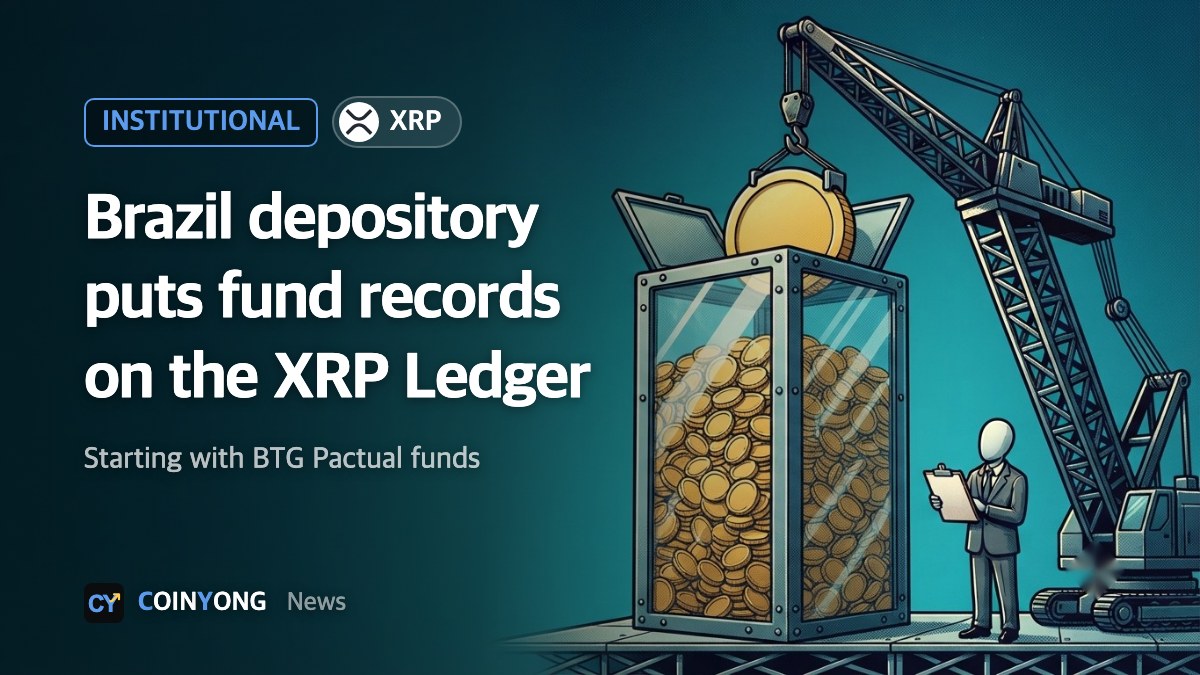
CSD BR will mirror ownership records of BTG Pactual fund shares on the XRP Ledger.
CSD BR's systems remain the official record; the blockchain serves as a supplementary layer for querying and auditing.
Native issuance and trading of real estate and agribusiness receivables are being considered for later phases.
CSD BR, a Brazilian registrar, central securities depository and settlement system, will begin mirroring ownership records of investment fund shares managed by investment bank BTG Pactual on the XRP Ledger (XRPL), a public blockchain. CSD BR announced the move on Sept. 29 as the first phase of a strategic partnership with Ripple. The companies said it is the first time a central securities depository will use a public blockchain to mirror securities ownership records.
CSD BR is a financial market infrastructure authorized by the Central Bank of Brazil to provide registration, depository and settlement services, and by the Brazilian Securities and Exchange Commission (CVM) to provide registration and depository services. It has more than 22 trillion reais in registered assets.
The official record stays put; the blockchain holds a copy
In this first phase, the blockchain acts as a supplementary ledger. BTG Pactual fund shares deposited at CSD BR will be tokenized and mirrored on the XRP Ledger using the Multi-Purpose Token (MPT) standard, while CSD BR's systems remain the official source of record for registration, deposit and settlement. The assets themselves are not moving onto the blockchain.
The copy is meant for reconciliation. Authorized participants can query the records on the blockchain in near real time and check that they match CSD BR's. Today, banks keep their own books and compare them with the depository's records after the fact, a slow and costly process. The companies said the model was developed within the current regulatory framework, without changing participants' legal responsibilities or requiring new regulatory approvals.
"We chose to start with record mirroring because it is the safest and most responsible way to introduce a new technology into critical market infrastructure. In this phase, current processes remain unchanged for investors, issuers and participants."
Daniel Polano Spreafico, Head of Products and Clients, CSD BR
Visible to anyone, but not open to everyone
The records sit on a public blockchain, but participation is permissioned. The environment is restricted to corporate and banking clients in Brazil subject to regulatory Know Your Customer (KYC) and anti-money laundering (AML) procedures. CSD BR retains full control over issuance and administration, including participant authorization mechanisms, the ability to freeze individual assets and the ability to reverse transactions (clawback) when required by regulatory or judicial order.
MPTs are a way of issuing tokens on the XRP Ledger with institutional features built in. According to the XRP Ledger documentation, MPTs can be restricted so that only approved users may hold them or made non-transferable, can have a maximum supply, and can be configured so the issuer is able to freeze holders' balances or claw back tokens. Ripple said the architecture combines its custody infrastructure with the native capabilities of the XRPL.
Real estate and agribusiness receivables are next in line
Once the mirroring phase is validated, the companies plan to gradually expand to native asset issuance on the blockchain and to trading among authorized participants. Assets under consideration for the next phases include Real Estate Receivables Certificates (CRI) and Agribusiness Receivables Certificates (CRA), significant segments of Brazil's fixed income market. The platform will also add confidentiality mechanisms to meet the financial market's privacy requirements, and while it starts with Brazilian assets and institutions, the model was designed to allow future expansion to other asset classes and international markets, the companies said.
"Moving beyond pilots and proofs of concept to a live record-keeping infrastructure in a national capital market is a major milestone for the industry," said Silvio Pegado, Managing Director of Ripple for Latin America. Luis Furtado, the BTG Pactual partner responsible for market infrastructure, said, "Mirroring fund shares creates a concrete foundation for future developments while preserving current processes and the official record of the assets."
Korean prices track global markets
XRP is listed on the Korean won markets of both Upbit and Bithumb. As of 5:30 p.m. KST on Sept. 30, XRP traded at 2,028 won on Upbit and 2,029 won on Bithumb. At the same time, it was at $1.494 on Binance, down 0.9% over 24 hours.
The kimchi premium (the gap between prices on Korean exchanges and global markets) stood at about 0.3% on Upbit at the same time, leaving little difference. The most recent funding rate on Binance's XRP perpetual futures (a fee exchanged between longs and shorts to keep futures prices in line with spot) was 0.0003%, close to neutral.
More crypto news
 NEAR
NEAR
 ONDO
ONDO