Ripple and XRPL Foundation launch XRP Asia, a dedicated hub for Asia-Pacific builders
 Coinyong
 XRP
XRP
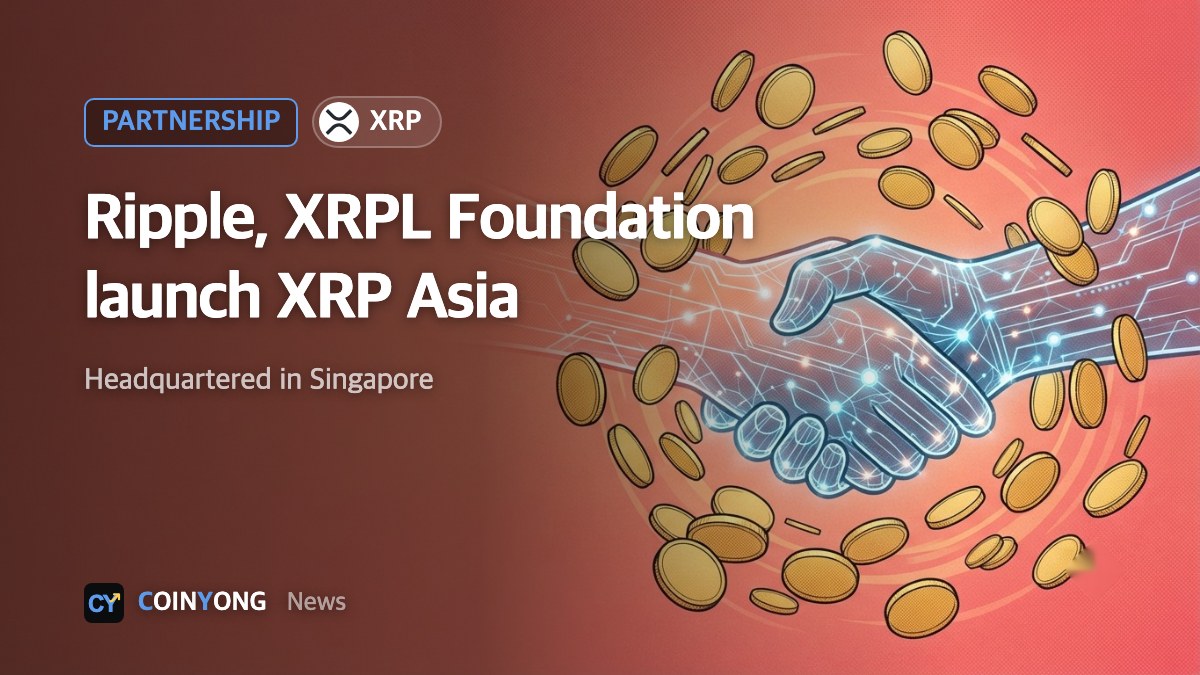
Ripple and the XRP Ledger Foundation jointly founded XRP Asia on Oct. 3.
The Singapore-based group is led by former Hedera Foundation executive Sabrina Tachdjian.
Three XRPL amendments are set to go live on mainnet Oct. 9 if validator support holds.
Ripple and the XRP Ledger Foundation (XRPLF) have set up XRP Asia, a dedicated organization to grow the XRP Ledger (XRPL) ecosystem across Asia-Pacific. In a launch post on its official X account on Oct. 3, XRP Asia said its vision is "to make XRPL the go-to blockchain for builders across Asia and for the region to become a major engine of growth and adoption for the broader XRP ecosystem." The jointly founded group will handle developer education, startup support and regional community programs.
A Singapore base built on Seoul and Tokyo communities
XRP Asia is headquartered in Singapore. It will build on two existing communities, XRPL Korea and XRPL Japan, while helping establish and support new communities across major Asian cities and development hubs. Its official website lists Singapore, Tokyo and Seoul as hub cities.
The organization is led by Sabrina Tachdjian, who previously led APAC and Fintech/Payments at the Hedera Foundation and before that headed blockchain investments at LINE. XRP Asia pointed to the significant share of XRPL developers based in the region and growing institutional adoption as reasons for its creation.
It is not Ripple's first dedicated push in the region. On June 11, 2024, Ripple announced a fund to support the XRPL ecosystems in Japan and Korea, saying it would commit tens of millions of dollars over time. At the time, Korea's Moai Finance and Japan's VWBL were among the recipients of the seventh wave of XRPL Grants.
Support that continues after the hackathon
XRP Asia plans to develop XRPL learning resources designed to make it as easy as possible for newcomers to start building. It is also launching a new SI Partnership Program for system integrators and development shops, saying that with a significant share of the world's SIs and development firms based in Asia, the region is a natural place to start the initiative.
The group will run and support hackathons. Once a hackathon ends, developers will still have access to office hours, ship-it clinics and other programming in APAC-friendly time zones. For startups, it will provide go-to-market help, including guidance on XRPL-enabled infrastructure and service providers, partner introductions and connections to incubation and grant programs across the XRPL ecosystem. As companies grow, it will also support joint events and investor introductions. The launch post did not disclose the size of any investment fund run directly by XRP Asia.
Three upgrades could go live as early as Oct. 9
Three mainnet rule changes, known as amendments, are currently pending on XRPL. An amendment is enabled only after it holds support from more than 80% of trusted validators for two weeks; if support falls below that level, the two-week period restarts. According to XRPSCAN data as of midday Oct. 4 KST, the threshold stands at 28 of 35 validators.
PermissionDelegationV1_1, which lets an account hand specific permissions such as payments or token issuance to another account, has 29 supporting validators. BatchV1_1, which processes multiple transactions as a single batch, has 30, and fixBatchV1_2, a security fix that rejects improperly wrapped batch inner transactions, has 34. All three crossed the threshold on Sept. 25. If support holds, PermissionDelegationV1_1 will activate around 6:25 a.m. KST on Oct. 9 and the other two during the 11 p.m. hour KST that day.
The XRP Ledger Foundation released emergency server version 3.4.1 with the security fix on Sept. 25, urging node operators to upgrade as soon as possible. Once the new rules are enabled, servers running older versions will be unable to determine the validity of a ledger or process transactions.
XRP trades just above 2,000 won on Upbit
XRP traded at 2,022 won on Upbit's Korean won market around 12:30 p.m. KST on Oct. 4, up 0.1% from 24 hours earlier. At the same time it was at $1.488 on Binance, putting the Upbit price about 0.7% above the global price converted into won, a gap known as the kimchi premium. On Bithumb it traded at 2,023 won.
More crypto news
 TRUMP
TRUMP
 POD
POD
 NEAR
NEAR
 USDC
USDC