Cardano launches token standard that lets issuers freeze and seize tokens on mainnet
 Coinyong
 ADA
ADA
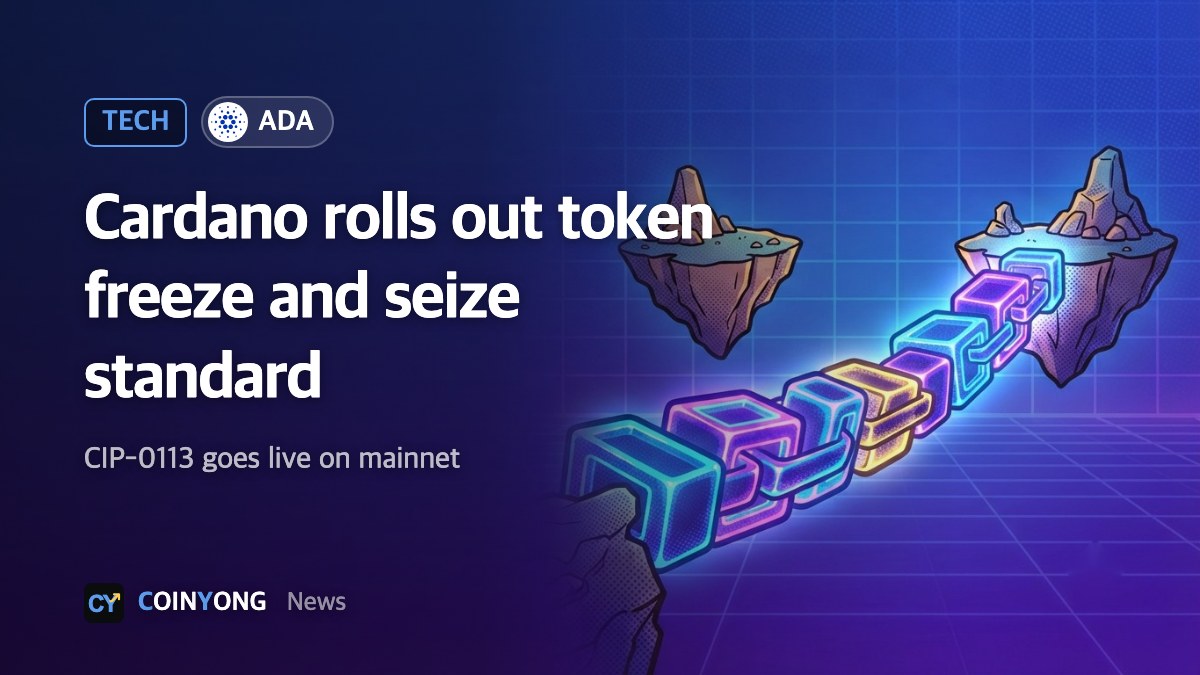
The Cardano Foundation said its programmable token standard CIP-0113 is live on mainnet.
Issuers can embed KYC, sanctions, freeze and seize rules that the ledger enforces on every transaction.
No hard fork was needed; the rules apply only to tokens issued under the standard, and CMTA recognized it.
Companies that issue tokens on the Cardano (ADA) blockchain can now freeze or claw back those tokens without the holder's consent. The Cardano Foundation said on Oct. 7 (KST) at the TOKEN2049 conference in Singapore that its new token standard, CIP-0113, is live on Cardano mainnet. The foundation added that the standard had completed multiple independent security audits.
The standard is aimed at issuers of regulated assets such as stablecoins, tokenized funds and bonds. Issuers can build rules such as know-your-customer (KYC) and anti-money laundering (AML) checks, sanctions screening, freeze and seize, and transfer restrictions directly into their tokens. The Cardano ledger checks those rules every time a token is transferred, minted or burned.
Rules that travel with the token
Until now, Cardano's native tokens could move freely between addresses once they were minted. Tokens issued under the new standard must pass a script, or smart contract, on every transaction before they change hands. They are held at a shared contract used by all such tokens, with ownership determined by the wallet's stake credential. The foundation said the standard required no hard fork and that issuers can pick modular rule sets, known as modules, or write their own, and update them as regulation changes. It also stressed that tokens issued under the standard remain native Cardano assets, so wallets and explorers can handle them like any other token.
"Regulators have been clear about what tokenised financial assets need. The rules have to travel with the asset and be enforced every time it moves."
Frederik Gregaard, CEO of the Cardano Foundation
Wallets Eternl and GeroWallet, explorer CardanoScan and developer tool BloxBean supported the standard at launch. The Swiss Capital Markets and Technology Association (CMTA) said the same day it had recognized the standard as equivalent to its own CMTAT token framework, meaning it can be used to certify ledger-based equity securities in Switzerland. The foundation noted that international standard-setters, including the Bank for International Settlements (BIS) and the International Monetary Fund (IMF), have identified the ability to hard-code compliance conditions into an asset as central to the next generation of tokenized markets.
'Third-party actions' that need no holder signature
According to the CIP-0113 document, each token can have its own third-party action contract. Parties named in that contract can seize tokens or force transfers without the holder's permission. They can also seize only part of a balance, or seize and burn tokens in the same transaction. Seized tokens, however, cannot leave the shared contract, and who can take which action is written in each token's public contract.
The document also spells out a limitation. When several tokens sit in a single bundle, or UTXO, freezing one of them also locks the other tokens in that bundle. To address this, the standard lets holders split the frozen token off into its own output, but only if the issuer allows it. It advises lending protocols to check whether a token has freeze or seize functions before accepting it as collateral.
The rules apply only to tokens newly registered under the standard. ADA, Cardano's native coin, and ordinary tokens already in circulation are not subject to freezing.
Three years and nine months since the proposal
The standard was first submitted as a proposal to the Cardano Improvement Proposals repository in January 2023. The Cardano Foundation opened a platform on the Preview testnet that anyone could try on March 9, 2026, and the proposal was merged into the official repository on Sept. 29. Phil di Sarro, CEO of developer Anastasia Labs, worked on the original design, and the foundation's team refined the implementation in the Aiken programming language. "The Cardano Foundation's team has brought rigour to the Aiken implementation, and our collaboration has made the standard stronger," di Sarro said. The foundation said it will develop a securities module and work directly with institutions that want to use the standard.
ADA fell along with a broad decline across the crypto market. As of 5:30 p.m. KST on Oct. 7, ADA traded at 350 won on Upbit, down 3.3% from the previous day, and also at 350 won on Bithumb. On Binance it was at $0.2582, down 5.4% over 24 hours. The Upbit price was about 1.2% above the overseas price converted into won, a gap known as the kimchi premium (the difference between prices on Korean exchanges and global markets). ADA's 24-hour trading volume was about 32.2 billion won on Upbit and about 8.8 billion won on Bithumb.
In the futures market, the funding rate on Binance's ADA perpetual futures stood at -0.0107% at the same time, meaning short positions, or bets on a decline, were paying longs. The funding rate is a fee that longs and shorts exchange periodically to keep futures prices in line with the spot market.
More crypto news
 XRP
XRP
 USDT
USDT
 PENGU
PENGU