CleanSpark sells 702 bitcoin in September, ends monthly mining updates
 Coinyong
 BTC
BTC
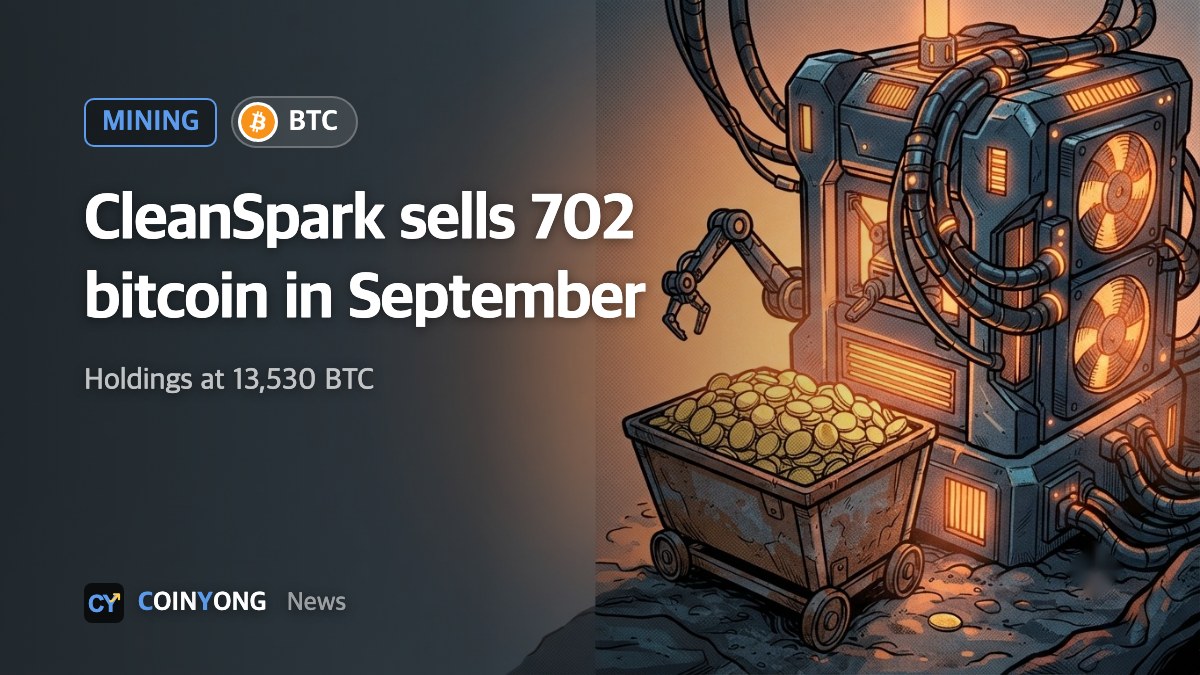
CleanSpark mined 529 BTC and sold 702 in September; holdings fell to 13,530 from 13,703.
Of the bitcoin sold, 700 were delivered when call options the company had sold were exercised.
It closed $2.276 billion of notes for a Georgia data center and will stop monthly updates.
Nasdaq-listed bitcoin miner CleanSpark (CLSK) mined 529 bitcoin in September and sold 702, according to its September operational update released on Oct. 9 (U.S. time). The company said it held 13,530 bitcoin as of Sept. 30, 173 fewer than the 13,703 it held a month earlier.
Average daily production was 17.64 bitcoin, with a peak single day of 18.99. The company has produced 5,432 bitcoin so far in calendar year 2026. CleanSpark said the figures are unaudited.
700 bitcoin went out through call exercises
Only 2 of the 702 bitcoin sold were sold at spot. The remaining 700 were delivered to counterparties when call options the company had sold were exercised. A call option gives the buyer the right to purchase bitcoin at a set price, and the seller collects a premium for granting that right. CleanSpark said its average price of $72,928 per bitcoin sold is calculated as net proceeds from bitcoin sold plus net premiums generated, divided by total bitcoin sold.
The pattern was similar in August. According to the August update released on Sept. 8, CleanSpark mined 593 bitcoin and sold 821 that month, including 500 sold pursuant to call exercises and 244 sold in connection with basis trades, which seek to profit from the price gap between futures and spot. The average price per bitcoin sold in August was $65,420. Holdings have fallen by about 400 bitcoin in two months, from 13,931 at the end of July. Of the holdings at the end of September, 3,475 bitcoin were posted as collateral or held as a receivable, all related to derivative transactions.
$2.276 billion of notes for a Georgia data center
CleanSpark led the update with its data center financing. Its wholly owned subsidiary, CSDC Finance I, LLC, closed on Sept. 25 an offering of $2.276 billion of 7.875% senior secured notes due 2031. The notes have not been registered under the Securities Act of 1933 and were not a public offering. Annual interest at face value comes to more than $170 million. The proceeds fund the build-out of a data center in Sandersville, Georgia.
The Sandersville project is tied to a 20-year lease CleanSpark announced on July 14. The company described the tenant only as a high-investment-grade global technology company and did not name it. Deliveries of 175 MW of critical IT load are expected to begin in the fourth quarter of 2027, and CleanSpark said it expects about $6.6 billion of contracted revenue over the initial 20-year term, or $11.6 billion if two five-year extension options are exercised.
"With non-dilutive bond financing now in place, our Sandersville project is fully funded through completion."
Matt Schultz, CEO and Chairman of CleanSpark
Schultz said the company is continuing the commercial process across its entire portfolio while monetizing its contracted power through bitcoin mining in the meantime. He added that demand for power and land remains relentless.
September was the last monthly mining update
CleanSpark said it will move to standard quarterly reporting, consistent with peers in the energy and data center sectors, and will discontinue monthly operational updates. The company's fiscal year ends on Sept. 30, making the September report its final monthly update. Schultz said CleanSpark is starting its new fiscal year from a position of strength.
The company has 1.8 GW of power under contract and 808 MW utilized. Its deployed fleet stood at 199,745 miners, and its operational hashrate, the highest computing power its installed miners have achieved together, is 50 exahashes per second. Average operating hashrate in September was 36.0 EH/s, down from 38.3 EH/s in August.
As of about 10:30 p.m. KST on Oct. 11, bitcoin traded around $83,000 on Binance, 113.02 million won on Upbit and 113.01 million won on Bithumb. Korean prices carried a kimchi premium (the gap between prices on Korean exchanges and global markets) of about 1.4%.
More crypto news
 ONT
ONT
 XRP
XRP
 STRK
STRK