Starknet weighs leaving Ethereum to become a layer 1; STRK more than doubles in three days
 Coinyong
 STRK
STRK
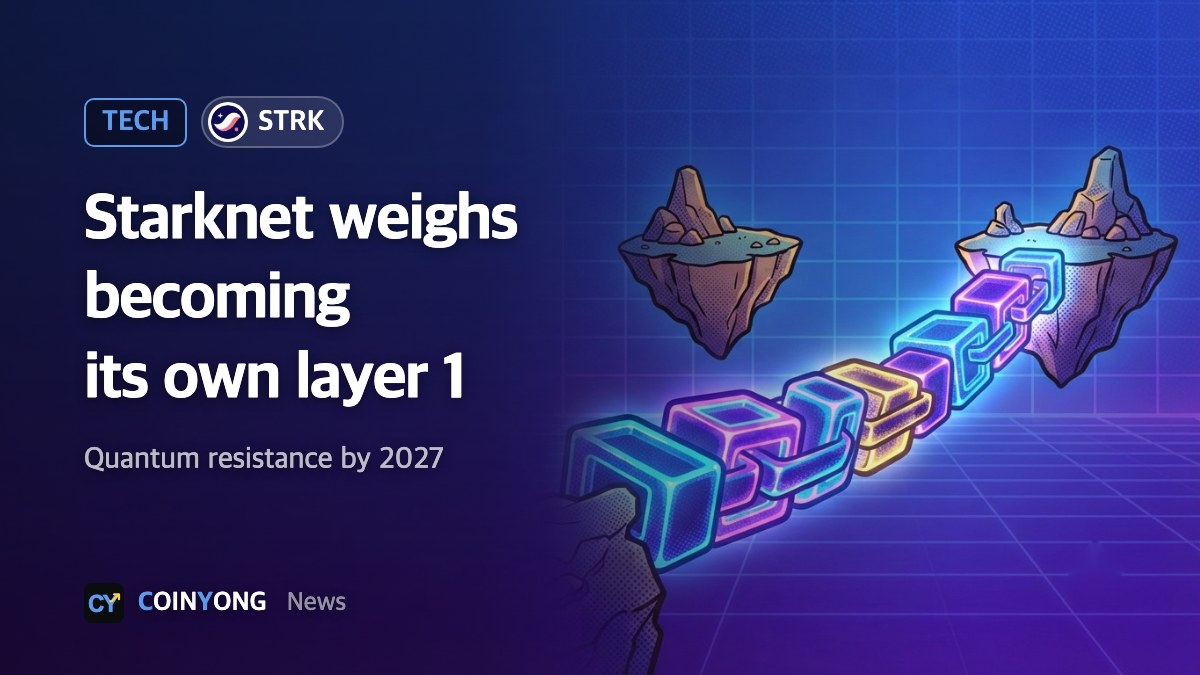
Starknet said it is "actively considering becoming an L1," with 2027 as its quantum-resistance target.
No vote, decision or migration timeline has been announced.
STRK rose from $0.049 to $0.106 on Binance; 24-hour volume on Bithumb hit 12.9 billion won.
Starknet, a layer-2 (L2) network that runs on top of Ethereum, said on Oct. 8 it is considering becoming an independent layer 1 (L1). "We are actively considering becoming an L1," Starknet wrote on its official X account. "This would enable Starknet to become the first fully quantum-resistant network, with 2027 as our target." No transition vote, decision or detailed timeline has been announced.
Not waiting for Ethereum to go quantum-safe
The idea came from Eli Ben-Sasson, chief executive of StarkWare, the company that built Starknet. At 5:19 p.m. KST on Oct. 8, Ben-Sasson posted a thread on X that opened with the question, "Starknet becoming an L1 for post-quantum agility: good idea or bad idea?" Thirteen minutes later, Starknet's official account quoted the thread and said it was considering the move. Ben-Sasson said the thread summarized his Token2049 talk that day.
Quantum computers are expected to one day be able to break the elliptic-curve cryptography that secures blockchain wallets today. Ben-Sasson wrote that the quantum threat "may be MUCH closer than we think," and pointed to the pace of AI-driven mathematical breakthroughs as a new threat as well. As an L2, he said, Starknet relies on the security of Ethereum, its L1, and needs Ethereum to become quantum-safe first. "What happens if it doesn't?" he asked. Becoming an L1 would give Starknet control over its own security migrations rather than having to wait for Ethereum or Bitcoin to move first, he said.
"For context, Ethereum is targeting full L1 quantum resistance by the end of 2029. Bitcoin has made no such commitment. Starknet could get there by 2027."
Eli Ben-Sasson, CEO of StarkWare
Proofs are already hash-based; the Ethereum links are what remain
STARKs, the proof system that bundles and verifies Starknet transactions, rely on hash functions rather than elliptic curves. In a July 20 post on its official blog, StarkWare said STARKs "rely only on post-quantum secure hash functions for their cryptographic commitments." Every Starknet account is a smart contract, so each account can switch signature schemes without a hard fork, and OpenZeppelin and others have published account contracts using the post-quantum Falcon-512 signature scheme. The company added that those contracts are still early and have not been audited.
In the same post, StarkWare wrote that, as an Ethereum L2, Starknet's full-stack quantum safety depends on Ethereum completing its own transition. The bridge's messaging layer, which passes messages to and from Ethereum, and the data availability layer, which posts transaction data to Ethereum, still rely on elliptic-curve cryptography. Bridged assets held in Ethereum contracts also remain vulnerable to quantum attacks, it said. The L1 option was presented as a way to cut that dependency, but how Starknet-related apps and assets on Ethereum would be migrated has not been disclosed.
STRK doubles as futures traders lean short
On Binance spot, STRK closed at $0.04907 on Oct. 7 (UTC), the day before the announcement. It rose as high as $0.0625 on Oct. 8 and hit $0.10818 on Oct. 10. At 10:30 a.m. KST on Oct. 11, it traded at $0.1057, more than double its pre-announcement level. Open interest in Binance STRK futures nearly quadrupled, from $11.9 million at 00:00 UTC on Oct. 8 to $45.4 million at 00:00 UTC on Oct. 11.
Short accounts outnumbered long accounts in futures. As of 10 a.m. KST on Oct. 11, 41.1% of Binance STRK futures accounts were long (betting on a rise) and 58.9% were short (betting on a fall), and the funding rate was close to 0%.
STRK is not listed on Upbit's Korean won market but trades against the won on Bithumb and Coinone. At 10:30 a.m. KST on Oct. 11, STRK was 142 won on Bithumb, with 24-hour trading volume of about 12.9 billion won. It traded at 144.7 won on Coinone. Converted to won, the Binance price was about 142 won, leaving almost no kimchi premium (the gap between prices on Korean exchanges and global markets) on Bithumb.
More crypto news
 XRP
XRP
 DOT
DOT
 BTC
BTC