Argentine judge dismisses LIBRA memecoin case against Milei and 10 others
 Coinyong
 LIBRA
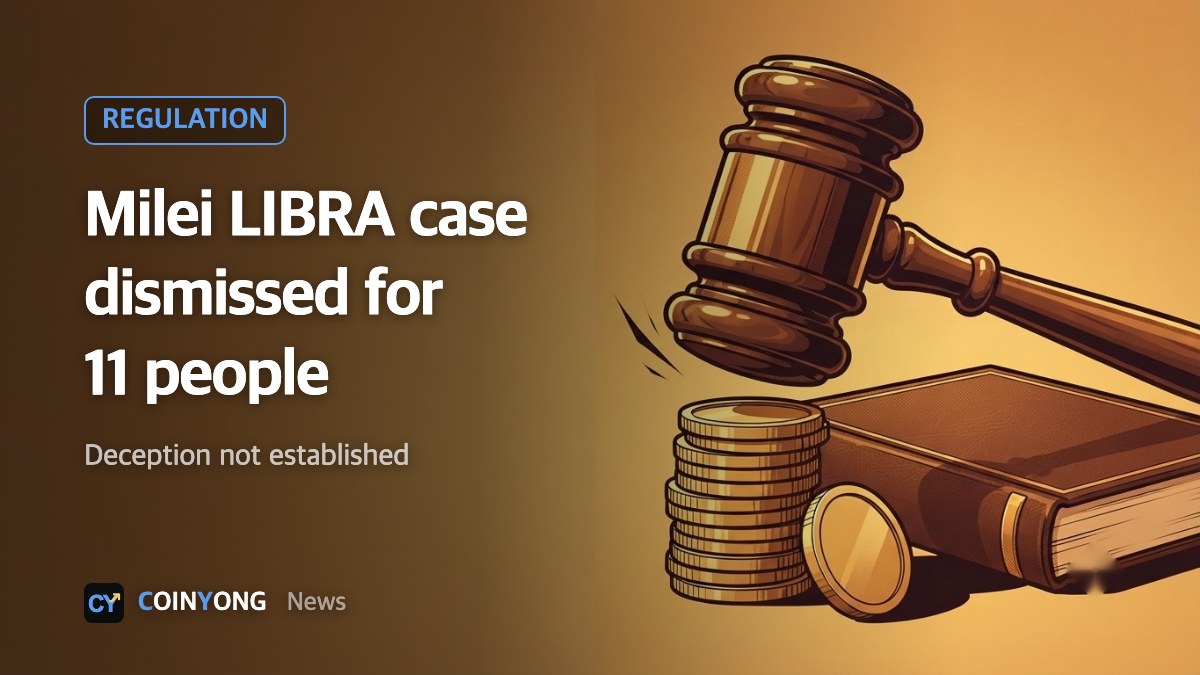
Argentina's Federal Criminal Court No. 8 dismissed the case against President Milei and 10 others on Oct. 23.
The judge said the president's promotion may have influenced some buyers' trust but was not by itself a fraudulent scheme.
Prosecutors had sought the dismissal, and none of the 11 was ever questioned as a suspect.
Argentine federal judge Marcelo Martínez de Giorgi of Federal Criminal and Correctional Court No. 8 on Oct. 23 dismissed the LIBRA memecoin case against President Javier Milei, his sister and presidential secretary general Karina Milei, and nine others. The 60-page ruling concluded that "the events reported do not fit any legal criminal offense." A dismissal, or sobreseimiento, ends a case without trial because no crime has been established.
Those cleared also include Hayden Davis of Kelsier Ventures, the token's issuer, Julian Peh of KIP Protocol, and lobbyist Mauricio Novelli, who was identified as a go-between for the president and the industry. The ruling added that the proceedings "do not affect the good name and honor" of those involved. None of the 11 was ever questioned as a suspect, and eight of them had retained defense lawyers.
One post, one year and eight months
- Milei posted about LIBRA and its Solana contract address on his X account (@JMilei)
- Criminal complaints followed, and lawmakers and other complainants appeared in court to expand on them
- Federal police raided homes linked to those involved and seized phones, documents and cash
- The U.S. District Court for the Southern District of New York dismissed investors' civil suit against Kelsier Labs
- The court granted prosecutor Eduardo Taiano's request for dismissal
The New York court found it lacked jurisdiction over the Davis family and Kelsier, and threw out claims against Chow, a defendant linked to Solana-based decentralized exchange Meteora, finding insufficient grounds to show fraudulent intent. The Argentine judge cited that U.S. ruling in his decision.
According to the complaints as summarized in the ruling, LIBRA started at $0.01, surged to nearly $5 right after the president's post and collapsed within hours. The complainants alleged that a handful of wallets pulled out about $100 million and that more than 40,000 buyers suffered losses.
"Celebrity promotion is not fraud by itself"
The judge held that fraud requires a specific false representation, a resulting error by buyers and a loss, all linked together. The ruling acknowledged that "the institutional office of the person who promoted the project could have given it particular reach and visibility and, possibly, influenced the trust some buyers placed in it," but said "the notoriety of a promoter or the publicity of a launch do not, by themselves, amount to a fraudulent scheme." In the judge's view, the complainants failed to pinpoint which part of the project had been presented falsely.
The abuse of authority and negotiations incompatible with public office charges ended the same way. On abuse of authority, Argentina's Anti-Corruption Office said the post was made on a personal account rather than an official presidential one and involved no public resources or administrative acts. On the negotiations charge, the judge compared the post to "the president attending the opening of a factory or business" and found no basis to treat it as a deal tied to his office.
The bribery allegations were also rejected. Novelli's phone held a note listing money to be paid to the Milei siblings and traces of an Apple Notes entry reading "final agreement as discussed with H," but investigators found no record of the note being sent to anyone. Novelli's bank safe-deposit boxes were empty when raided. The only record linking Karina Milei to Davis was her authorization of his entry to the presidential palace on July 16, 2024, which the judge said does not by itself prove an illicit agreement. Businessman Diógenes Casares and Cardano founder Charles Hoskinson, who had publicly said they were asked for money to meet the president, did not name Karina Milei.
The judge also noted that an internal inquiry confirmed an employee of the prosecutors' technical unit, which analyzed the digital evidence, had improperly accessed confidential case files. A request for legal assistance from the United States was closed by U.S. authorities, who said the material provided was insufficient.
Milei asks who will compensate him as investors look to a higher court
Milei wrote on X the night of the ruling: "Who compensates me now for a year, eight months and nine days of lies, slander and insults," adding that "Justice once again put things in their place."
The case may not be over yet. According to The Block, prosecutors are not expected to appeal, but five investors who lost their standing as criminal complainants in July have asked the Federal Criminal Cassation Court to reinstate them. If it does, they would gain a path to challenge the dismissal. LIBRA is not listed on South Korean exchanges Upbit and Bithumb or on Binance.
More crypto news
 EGLD
 XMR
 XRP
 BMT