SBI DigiTrust, NICE and DSRV to test stablecoin QR payments for Japanese tourists in Korea
 Coinyong
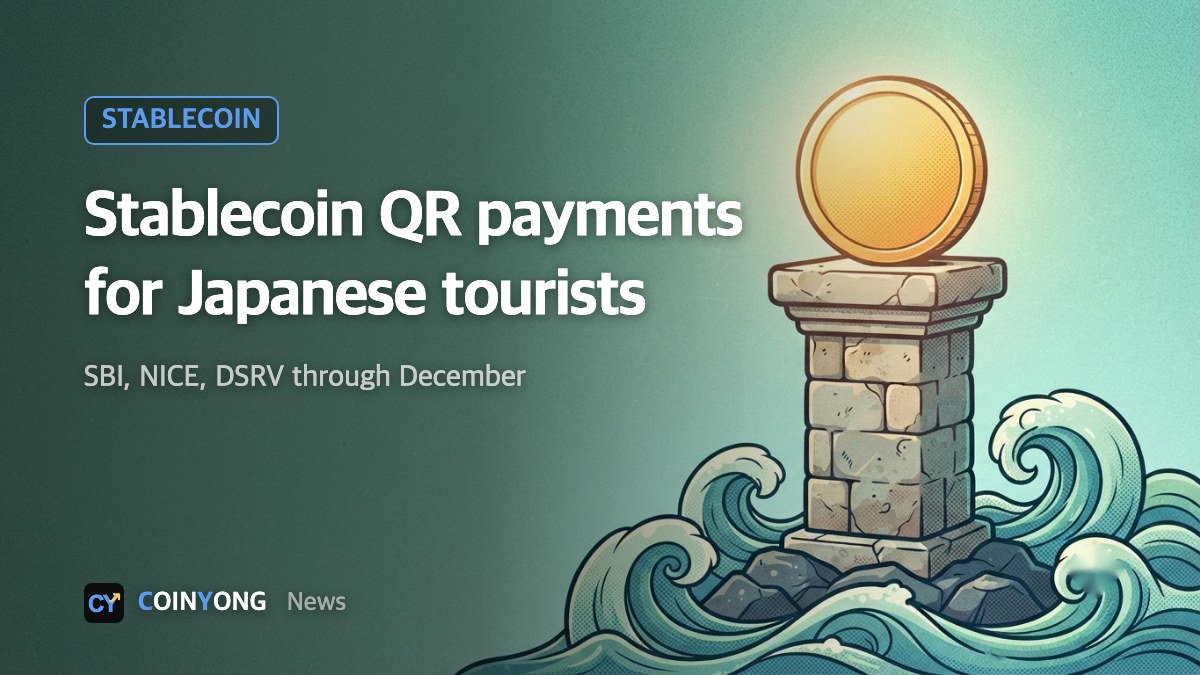
SBI DigiTrust, NICE Information & Telecommunication and DSRV signed an agreement in Seoul on Sept. 30.
They will test a QR payment route for Japanese users at NICE merchants through the end of December.
The stablecoin, blockchain and launch date were not disclosed, and commercialization will depend on the results.
Three Japanese and Korean companies will test a system in which a Japanese tourist pays at a Korean store by QR code and the money travels to the local merchant as a stablecoin, a cryptocurrency designed to track the value of a fiat currency. SBI DigiTrust, a blockchain infrastructure company in Japan's SBI Group, said on Oct. 1 that it had agreed with Korean payment processor NICE Information & Telecommunication and blockchain infrastructure firm DSRV to jointly verify stablecoin-based remittance and payments between Japan and Korea. The signing ceremony was held on Sept. 30 at NICE Information & Telecommunication's headquarters in Yeouido, Seoul, and the verification will run through the end of December.
How a Japanese tourist's payment reaches a Korean store
The test centers on Korean merchants under contract with NICE Information & Telecommunication. Assuming a Japanese user pays at one of these stores by QR code, the companies will work out in detail how the money moves from the Japanese user to the Korean merchant, how remittance and payment instructions are issued, and how each company's systems connect. SBI DigiTrust said it would also assess the business case based on expected transaction volume and costs, and lay out the issues that need to be settled before any decision on commercialization.
NICE Information & Telecommunication listed four areas to be tested: whether stablecoins can be used for payments and remittances between Korea and Japan, how existing financial and payment systems can be linked to blockchains, how payment and settlement between Japanese users and Korean merchants would be handled, and whether the business is viable given regulations and rules. The company said it supports more than 1.2 million merchants nationwide but did not say how many of them would take part in the test.
Who does what
- SBI DigiTrust: designs the remittance and payment structure with SBI Group companies, drawing on its knowledge of Japanese regulation, payments and digital assets
- NICE Information & Telecommunication: reviews operations, connections to existing payment systems and the business case on the premise of real merchant payments
- DSRV: reviews the technical requirements and system design needed to use stablecoins and blockchains, and how they connect to existing systems
"For stablecoin payments to be effective, a secure payment environment that both users and merchants can trust must come first."
Kang Se-hyun, managing director of the stablecoin task force at NICE Information & Telecommunication
NICE Information & Telecommunication said that ahead of the agreement it had been running on-chain stablecoin payment trials at offline merchants with Korean retail and fintech companies. On the same day, SBI Group disclosed that it had completed the process of making Japanese crypto exchange bitbank a wholly owned subsidiary.
Earlier tests involved financial institutions; this one adds a payment company
SBI Group announced Japan-Korea stablecoin plans and tests in August and September as well. On Aug. 7, affiliate SBI Digital Practice said it had decided to sign a memorandum of understanding with Korean company Nodeinfra and pursue the "Musubi Project," a Japan-Korea payment network built on the Canton Network, a blockchain for financial institutions. The two companies noted that payments between Japan and Korea currently rely on sequential settlement through U.S. dollars, and said they would start by testing simultaneous settlement between yen and won test tokens, with a view to using regulated stablecoins as the two countries' frameworks allow.
On Sept. 17, SBI Digital Practice and Kyobo Life Insurance said they had verified, in a Canton Network test environment, the process of sending a test token modeled on a yen stablecoin from Japan and receiving it in Korea. Kyobo Life is an equity-method affiliate of SBI Holdings. While those two projects dealt with moving money between financial institutions, this verification includes NICE Information & Telecommunication, which runs payment services in Korea. SBI DigiTrust said this allows the test to be based on use at actual stores.
The coin has not been named
Neither SBI DigiTrust's nor NICE Information & Telecommunication's announcement said which stablecoin would be used, which blockchain or wallet would be involved, or when a service would launch. The end of December is when the verification ends, not a launch date. The three companies said only that they would use the results to judge whether commercialization is feasible.
The two countries' rules also differ. Since June 2023, Japan has classified fiat-pegged stablecoins as "electronic payment instruments," and intermediaries handling them must register with the Financial Services Agency under the Payment Services Act and other laws. SBI DigiTrust said in its announcement that Korea's stablecoin framework is still being developed, so the test will cover only what can be verified now, and the regulatory side will be reviewed as policy changes.
Dollar stablecoins trade against the won on Korean exchanges. Around 10:30 p.m. KST on Oct. 4, tether (USDT) traded at 1,356 won and USD Coin (USDC) at 1,358 won on Upbit, while tether traded at 1,358 won on Bithumb. That was about 0.5% to 0.7% above the won-dollar exchange rate of roughly 1,348.6 won tracked by Coinyong at the same time.
More crypto news
 BTC
BTC
 BGB
BGB
 XRP
XRP
 TRUMP
TRUMP