World Liberty sells ETH to pay down WLFI-backed loans as token halves in a day
 Coinyong
 WLFI
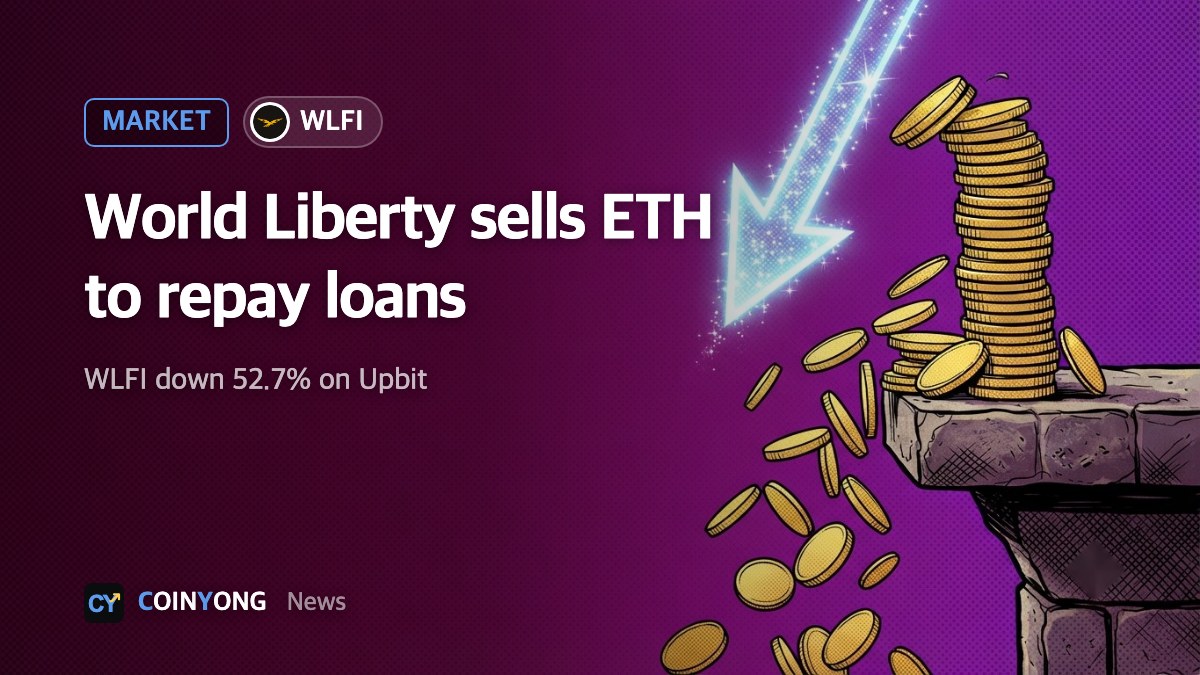
A treasury wallet sold about $20.06 million worth of ETH and mETH to reduce debt.
The liquidation price on WLFI collateral fell from above $0.02 to about $0.00631.
WLFI led daily trading on Upbit; the company said "not a single WLFI token was sold."
World Liberty Financial (WLFI), the DeFi project that lists members of the Trump family among its co-founders, said early on Nov. 29 KST on its official X account that it sold ether (ETH) from its treasury to pay down debt and cut the liquidation price on its WLFI collateral from above $0.02 to about $0.00631, a reduction of nearly 70%. The company stressed that "not a single WLFI token was sold as part of this process." In the day before the statement, WLFI fell to a record low on Binance, and the dollar-pegged stablecoin USD1 briefly slipped to $0.94.
From a pre-dawn ETH sale to a statement the next morning
- According to on-chain analytics accounts Lookonchain and EmberCN, WLFI's strategic reserve wallet sold 10,600 ETH and 1,378 mETH (Mantle staked ETH) for $17.58 million in USDC and $2.48 million in USD1, about $20.06 million in total. EmberCN estimated the average sale price at $1,655 and the realized loss at about $19.26 million.
- WLFI dropped 39% on Binance spot in 15 minutes, from $0.0345 to $0.0211.
- USD1 fell to 0.94 USDT on Binance. Lookonchain said Jump Crypto withdrew 43.26 million USD1 from exchanges over an hour and was redeeming it for $1.
- Tron founder Justin Sun posted on X calling for WLFI and USD1 to be delisted.
- WLFI said it "had no involvement" in Binance's automatic closing of WLFI perpetual futures positions.
- Binance said it was reviewing the market activity and execution data.
- WLFI disclosed how it had restructured its loans. Earlier, in the 3 a.m. hour, WLFI had fallen as low as $0.0156 on Binance.
Three loans became two, and two wallets were disclosed
WLFI said that over the past 24 hours it consolidated three lending positions into two, fully closed one of them and significantly reduced the debt on the rest. It published the addresses of the only two wallets tied to the loans and said claims attributing lending positions in other wallets to its treasury were inaccurate. The company said the moves were "not a reflection of diminished confidence in WLFI or the broader crypto market" but "a reflection of responsible treasury management."
According to The Block, WLFI pledged about 5 billion WLFI on the DeFi lending protocol Dolomite in April and borrowed $75 million in USD1 and USDC. Dolomite was co-founded by WLFI chief technology officer Corey Caplan. Citing contract data, The Block reported that on the morning of Nov. 28 U.S. time, after WLFI added another 1 billion tokens of collateral and cut about $10 million of debt, 4.99 billion WLFI were backing $21.5 million of USD1 debt.
On USD1, the company said "these treasury positions do not put USD1's reserves at risk." It said USD1 is backed 1:1 by reserve assets held at Fidelity, separate from these lending positions, and that anyone can verify this through monthly attestation reports by KPMG and a real-time proof of reserves powered by Chainlink. USD1 was back at 0.999 USDT on Binance as of 8 a.m. KST on Nov. 29.
Justin Sun calls for delisting as Binance reviews trade data
Sun alleged that the episode was a rerun of insider circular lending to cash out, unauthorized insider selling, the illegal freezing of investor assets and investor fraud, and called on exchanges, regulators and courts to add the tokens to warning lists, delist them immediately, restrict deposits and require disclosure of where the funds went. He also claimed team members were mass-deleting social media and communications but offered no evidence. According to CoinDesk, Sun invested about $30 million in WLFI from late 2024, had roughly 595 million of his WLFI tokens frozen in September last year, and sued WLFI in April this year. WLFI countersued for defamation in May.
According to The Block, some profitable short positions were forcibly closed during the crash through Binance's auto-deleveraging (ADL). ADL is a mechanism an exchange uses to reduce opposing positions when liquidation losses exceed available margin and insurance funds. WLFI said positions on both the long and short sides were closed automatically, stated that "Binance independently operates and manages its perpetual futures markets, including its auto-deleveraging mechanisms," and told affected users to contact Binance customer support.
Top trading volume on Upbit's Korean won market
As of 8:30 a.m. KST on Nov. 29, WLFI traded at 23 won on Upbit, 52.7% below the previous close of 48.6 won. On Bithumb it was 22.72 won. Upbit's 24-hour WLFI trading volume was about 132.6 billion won, the highest in its Korean won market. Binance's price at the same time was $0.0168, putting Upbit about 2.5% above Binance when converted at 1,335 won per dollar, a premium known as the kimchi premium (the gap between prices on Korean exchanges and global markets). The next funding rate for Binance's WLFI perpetual futures was around -0.03% at the same time, meaning shorts were paying longs. Upbit's notice board had no WLFI-related announcement at that time.
More crypto news
 XRP
 ETH
 BNB
 SKY