Bitcoin Breaks $76,000 — How Far Does the Downside Open?
 Coinyong
 BTC
BTC
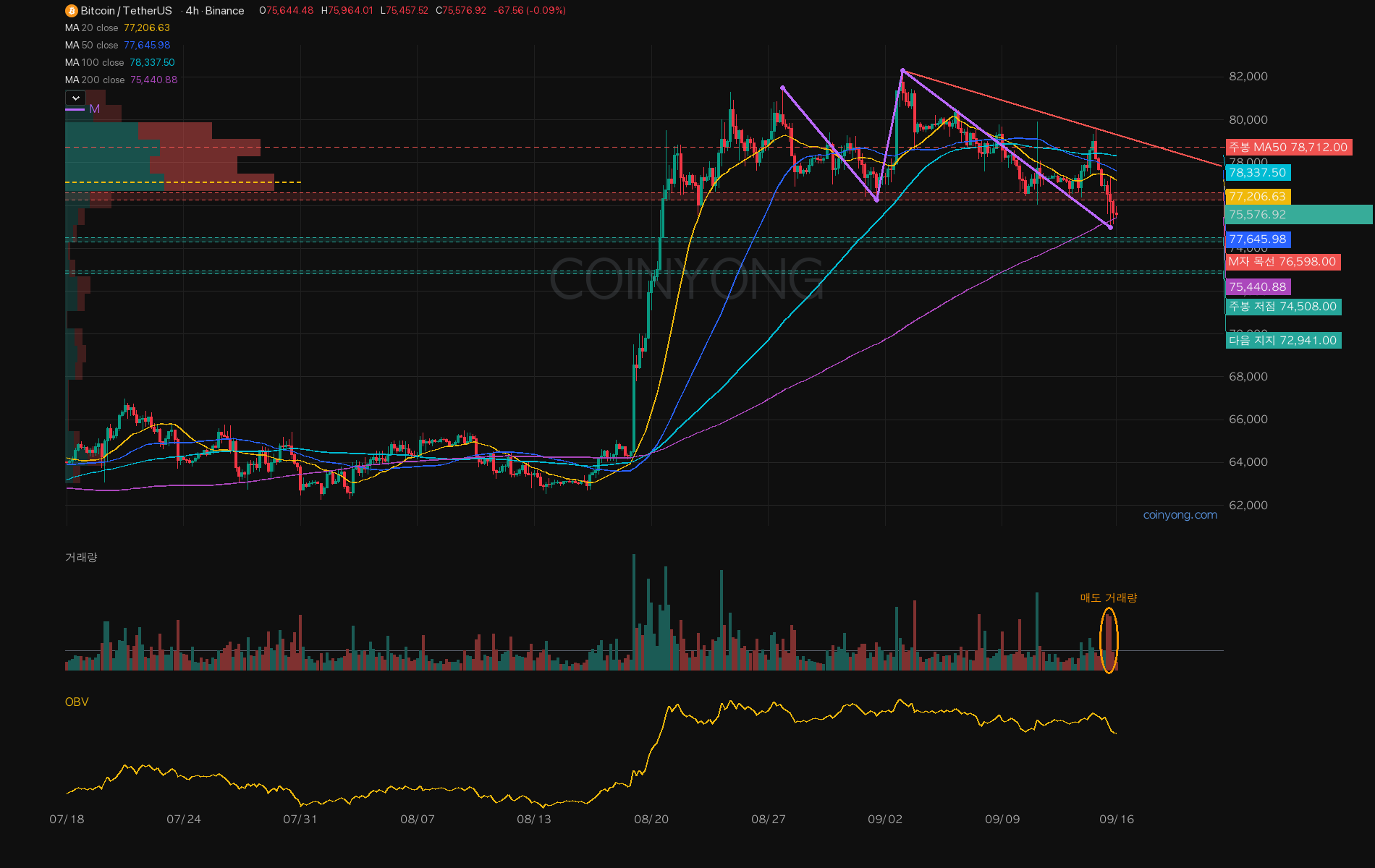
Bitcoin (BTC) failed to hold $76264, and the daily candle on the 15th closed at $75644. The downside path toward $74508 that we had to keep open is playing out.
On top of that, bad news came out of the US. A Senate vote to advance the digital asset market structure bill to debate failed 49 to 50. Falling well short of the 60 votes needed means the bill is stalled for now. The regulatory clarity the industry had been waiting for got pushed back again, which wasn't good news for the crypto market.
That said, BTC didn't suddenly drop because of one bill. It had already been sliding on the 4H before the vote, and after the result it dipped once more to $74968. A move that was already weak just got hit with bad news on top.
Overhead, the 50-week MA at $78712 and the downtrend line from early September are capping price, and below sits the first weekly support at $74508. The neckline of the M pattern on the daily, $76264, has already been broken.
The 4H itself has lower highs, from $79890 to $79600, and lower lows, from $76500 down to $74968. On the 15th, heavy sell volume showed up as well. For now, what matters is whether price gets back above $76598. Even so, if it can't clear $77332, it should be read as a brief bounce, not a trend change.
Selling dominated on the futures side too. While price fell 3.25% in a day, futures open interest (in coins) rose 3.8%. Large-order executions were about $270 million net selling, and the top-trader long share was 70.6%. That's a combination that can speed things up once price hits the liquidation zones below.
The first zone is where the $74500 bid wall and $74313 long liquidations sit together. If the daily breaks below this zone, next up is the $72941 and $72799 liquidation zone.
The Fed meeting also runs on the 15th–16th local time, so the announcement is still to come in the early hours of the 17th Korea time. If real buying doesn't show up at $74500, the volatility ahead of the announcement could get bigger.
The bill vote is over, but the larger volatility risk still lies around the Fed decision.
 ETH
ETH LINK
LINK