Ethereum staking reward burn proposal EIP-8363 pulled from Hegotá upgrade
 Coinyong
 ETH
ETH
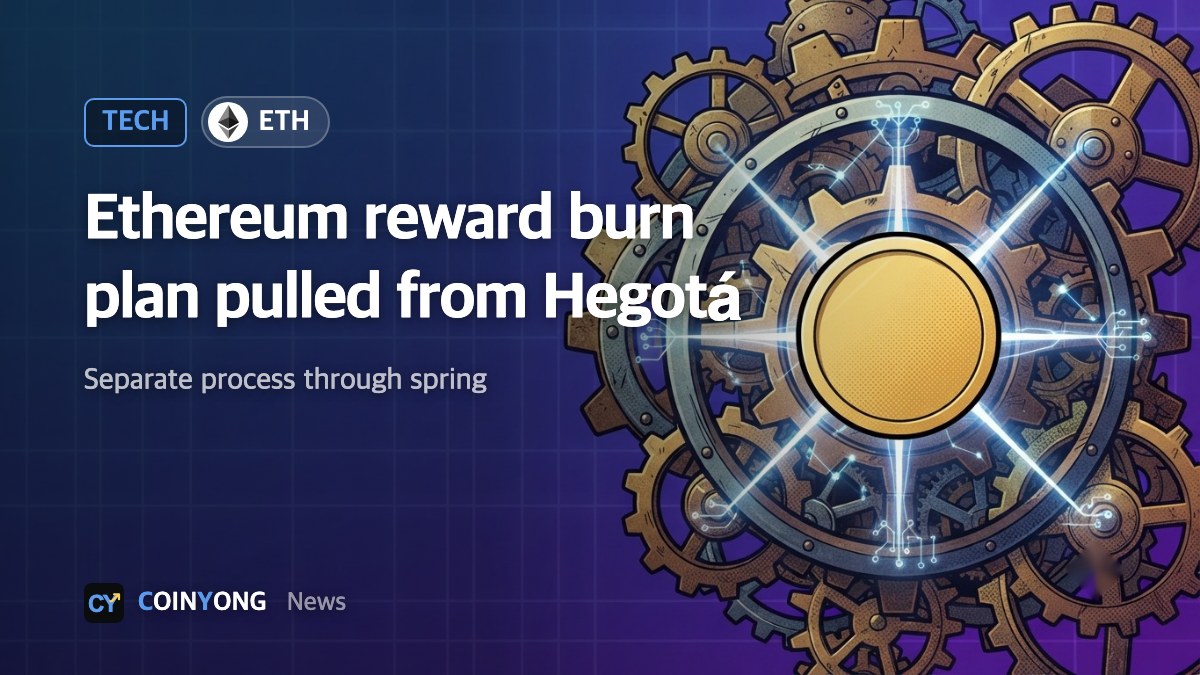
An EIP-8363 co-author withdrew it from Hegotá consideration on Oct. 1.
The plan burns more rewards as staking rises, fully canceling duty rewards at a 50% staking ratio.
Issuance policy moves to a separate process running from Devcon in November to EthCC next April.
EIP-8363, a proposal to burn part of Ethereum validator rewards, has been withdrawn from consideration for the network's next major upgrade, Hegotá. Co-author Jérôme de Tychey posted on the Ethereum Magicians developer forum on Oct. 1: "Withdrawing EIP-8363 from consideration for Hegotá." The authors said issuance policy will get its own process, with discussions running through next spring.
Burning more rewards as staking grows
EIP-8363 is titled "Tapered Issuance Burn." The draft was created on July 14 and opened for discussion on the forum on Aug. 4. Its six authors are pintail, de Tychey, dapplion, pa7x1, Ladislaus von Daniels and Justin Drake.
Under the proposal, a fraction of the reward for each duty a validator (a node that produces and verifies blocks) is assigned would be deducted and burned. The fraction rises as the share of all ETH that is staked increases, and at a 50% staking ratio it fully offsets the duty rewards. Under the current reward curve, the annual yield stays above a floor of roughly 1.5% no matter how much ETH is staked; the proposal aims to remove that floor. Because applying it all at once would cut yields sharply, it was designed to be phased in over 18 months.
The authors argued that a very high staking ratio concentrates stake among a small number of large operators, weakening the network's neutrality, and undermines the role of unstaked ETH as money. According to Validator Queue, which uses data from validator tracker beaconcha.in, 43.6 million ETH, or 35.75% of supply, was staked as of Oct. 1 evening.
A debate with more than 200 comments
In the withdrawal post, de Tychey wrote that EIP-8363 "rapidly became one of the most commented-on EIPs in the history of the forum, with 200+ comments in a few weeks." Critics said the change would directly cut the returns of holders who stake, and that solo stakers carrying fixed costs would be pushed out before large operators, which could concentrate stake even further.
The withdrawal came down to process. De Tychey said several parties in the industry as well as core protocol and client contributors had voiced that "a fork scoping exercise was not the right venue to settle an issuance policy change," and that the authors agreed. At the Sept. 17 consensus-layer developer call (ACDC #187), facilitator stokes had already been tasked with developing a plan for handling the decision process for the issuance EIP and presenting it at the next call.
The authors said they stand by the motivation of the proposal. They said the questions raised so far fall into five categories: security, industry impact, curve design, validator set composition and decentralization. They also said entities such as Lido had offered to help steer the separate process.
From Devcon to EthCC next April
The authors laid out the following draft timeline for the issuance discussion. The first forum was the EthCC 2026 roundtable.
| November, Devcon | Issuance Forum 2 — agree on problem statement, objectives and metrics |
|---|---|
| Post-Devcon to December | Workshop 1 — work through each objection, estimate the cost of keeping the status quo |
| January | Issuance Forum 3 (Columbia cryptoeconomics workshop, tentative) — converge on one proposal (draft EIP), or record why none emerged |
| February–March | Workshop 2 — harden the proposal, external review by academics |
| April, EthCC | Issuance Forum 4 — engage core developers and stakeholders, seek to enter the upgrade consideration stage |
Hegotá is Ethereum's next major upgrade, and developers are working through which proposals to consider for it. With the withdrawal, any change to issuance will be handled separately from Hegotá.
Ether at 3.675 million won on Upbit
As of 10:40 p.m. KST on Oct. 1, ether traded at 3,675,000 won on Upbit and 3,673,000 won on Bithumb, both in the Korean won market. Binance's price at the same time was $2,694, little changed from 24 hours earlier, and Upbit traded about 0.6% above Binance's won-converted price — a gap known as the kimchi premium (the difference between prices on Korean exchanges and global markets). Validator Queue put the average annual Ethereum staking yield at 2.64%.
More crypto news
 XRP
XRP
 USDC
USDC