Korea proposes tokenized securities rules with 100 million won retail cap
 Coinyong
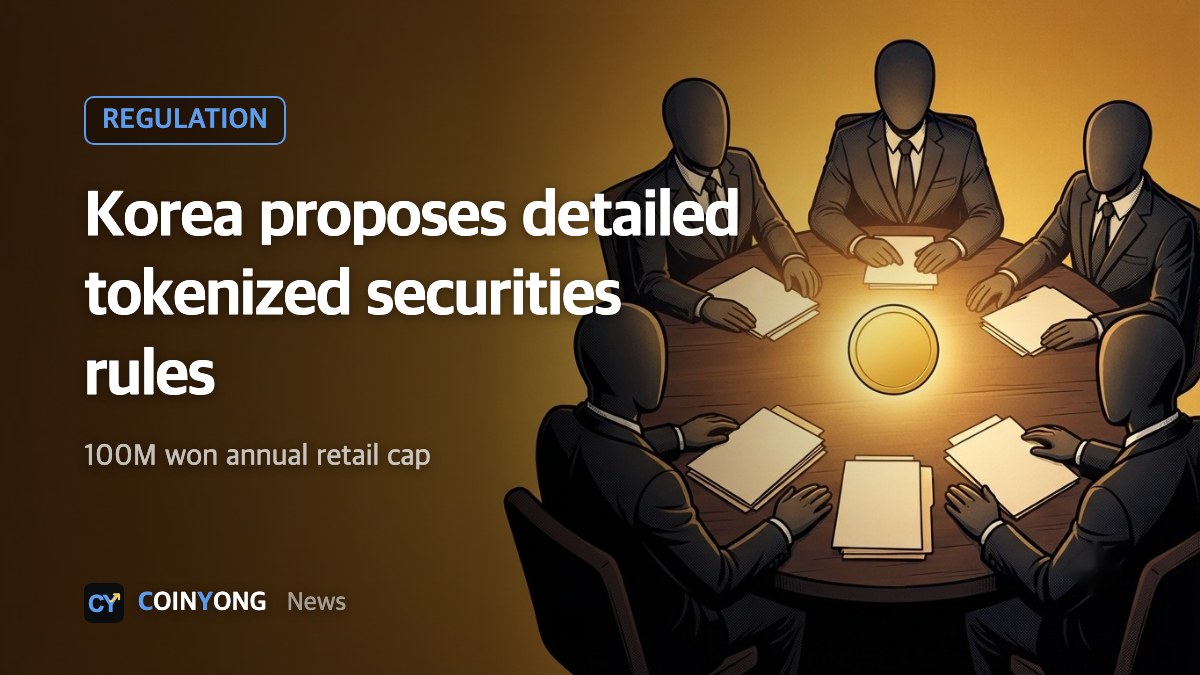
The FSC put draft tokenized securities rules out for comment from Oct. 2 to Nov. 11.
Stocks, bonds and funds could be tokenized, and debt securities are added as a new OTC exchange licensing category.
Retail buying is capped at 100 million won a year in net purchases per OTC exchange, with rules due Feb. 4, 2027.
South Korea's Financial Services Commission (FSC) on Oct. 1 released draft enforcement decrees and supervisory regulations that would let stocks, bonds and funds be issued as tokenized securities, recorded on blockchain-style distributed ledgers, once the country's tokenized securities regime takes effect on Feb. 4, 2027. The drafts will be open for public comment from Oct. 2 to Nov. 11. Retail investors buying tokenized securities on over-the-counter (OTC) exchanges would be capped at 100 million won in annual net purchases on each exchange.
Tokenized securities are securities issued and traded on a distributed ledger such as a blockchain. Unlike cryptocurrencies such as bitcoin, they are securities under the Financial Investment Services and Capital Markets Act, so public offerings require a registration statement and brokering them requires an investment brokerage license. The drafts set the detailed standards that the laws delegated to decrees and regulations, codifying the "tokenized securities policy direction" the FSC presented on Sept. 4 at the third meeting of its public-private tokenized securities council.
From fractional investments to stocks, bonds and funds
The draft rules under the Act on Electronic Registration of Stocks, Bonds, etc. (Electronic Registration Act) expand the securities eligible for tokenization beyond fractional investment securities, namely non-monetary trust beneficiary certificates and investment contract securities, to include conventional securities such as stocks, bonds and funds. Fractional investment products let many people split a stake in a single asset, such as artwork or a Korean beef cattle-raising business.
The drafts also set requirements for the ledgers. In addition to the Korea Securities Depository (KSD), the electronic registration entity, at least two account management entities must take part in running the ledger, to make its records more credible and keep operations running if something goes wrong. Because the distributed ledger becomes an official register, and to prevent delays in confirming rights, the drafts prohibit directly charging a fee in return for using the ledger for electronic registration.
Issuers managing accounts need 4 billion won in equity
The rules create "issuer account management entities," which would let securities issuers that are not financial companies directly manage customer accounts for the securities they issue. To register, an issuer would need minimum equity capital of 4 billion won, along with at least one account management professional, one internal control professional and two information technology professionals.
A 100 million won cap per OTC exchange for retail investors
The draft rules under the Capital Markets Act add debt securities as a new licensing category for OTC exchanges that trade tokenized securities, alongside unlisted stocks and non-monetary trust beneficiary certificates. The FSC said that while demand for bond trading between retail investors is still small, the change reflects the view that tokenization could reshape the bond trading market.
The retail investment cap is based on annual net purchases on each OTC exchange, meaning total purchases minus total sales over a year, with the limit set at 100 million won. The figure is unchanged from the September policy direction.
The FSC also listed calls from the industry to ease the rules in its press release: raising the retail trading cap on OTC stock exchanges, lowering the 4 billion won equity requirement for issuer account management entities, and relaxing the distributed ledger requirements. The FSC said it would consider these views thoroughly during the comment period and the formal legislative process.
Stablecoin settlement comes in the third and final phase
The framework rests on amendments to the Electronic Registration Act and the Capital Markets Act that passed the National Assembly on Jan. 15 this year. The amendments take effect on Feb. 4, 2027, and the new rules are also set to take effect that day after approval by the FSC, review by the Ministry of Government Legislation, and passage through the vice-ministerial meeting and the Cabinet.
| Jan. 15, 2026 | National Assembly passes tokenized securities amendments |
|---|---|
| Sept. 4, 2026 | Third council meeting, policy direction announced |
| Oct. 2 to Nov. 11 | Public comment period on draft decrees and regulations |
| Feb. 4, 2027 | Laws and rules scheduled to take effect |
According to the FSC's policy direction, the first phase at launch will tokenize private money market funds and private corporate bonds for institutional investors only, unlisted stocks through a trust structure, and publicly offered fractional investment securities. A second phase would expand to tokenizing publicly offered securities, and a third would build on-chain settlement infrastructure using stablecoins and other means of payment. The FSC said the timing of the move to the second and third phases could vary depending on factors including stablecoin legislation. The Korea Exchange will also run a pilot for tokenizing listed stocks.
More crypto news
 XRP
XRP
 ETH
ETH
 USDC
USDC